.webp)
.svg)
When the kids have moved out and retirement is either here or close, a large family home can start to feel like it belongs to a previous chapter. Bedrooms sit unused. Stairs become less convenient. Weekends can disappear into yardwork, repairs, and cleaning spaces that no longer support daily life.
For many empty nesters in Fairfax, Arlington, and Alexandria, downsizing is not only about moving into a smaller place. It is about choosing a home that fits the way life works now, with less maintenance, fewer physical demands, more freedom, and a budget that supports the next stage.
At Reputation Movers, we help homeowners across Northern Virginia and the greater DMV area plan local and long-distance moves, packing, storage, organizing, and home setup with the care these transitions deserve. If you have questions while thinking through a possible move, we are always happy to help you talk through the practical details.
Downsizing often starts when the family home no longer matches daily life
A home that worked beautifully for raising children can feel oversized once the household changes. Rooms that once had clear jobs, such as bedrooms, playrooms, homework spaces, or storage for sports gear, may become closed doors that are rarely opened.

Research on older movers shows that lifestyle change is one of the most common motivations for downsizing, especially after children leave home, retirement begins, or health needs shift. In one study, lifestyle and financial reasons each accounted for 27% of primary motivations to downsize, while maintenance concerns made up another significant share.
That balance matters. Many people assume downsizing is mainly a financial decision. For empty nesters and retirees, it is often just as much about making the home feel aligned with current routines, social life, travel plans, family visits, and physical comfort.
A right-sized home supports retirement routines instead of old household patterns
Retirement changes the way a home is used. Instead of serving school schedules, commutes, children’s activities, and full-family meals, the home may need to support quieter mornings, travel, hobbies, volunteering, family visits, and easier day-to-day living.
This is why many retirees look for homes that are easier to leave for travel, closer to amenities, or better suited for hosting grandchildren occasionally rather than maintaining unused rooms year-round. A smaller home can still be welcoming, but it does not have to carry the demands of a house built around a larger household.
In Northern Virginia, right-sizing can mean different things depending on location and lifestyle. Some homeowners trade a larger detached house for a townhouse, condo, or apartment in a more central area. Others move closer to adult children, friends, transit, healthcare, or community activities.
Lower maintenance is one of the strongest reasons to downsize your home
Maintenance is often the first thing that makes a large home feel burdensome. Cleaning multiple levels, caring for a yard, managing exterior repairs, shoveling snow, and coordinating contractors can take time and energy that many retirees would rather spend elsewhere.

In one late-life housing report, lower maintenance was cited by about 56% of respondents as the most important reason people downsized or would consider doing so. That finding reflects what many empty nesters already feel, which is that the home itself can become a recurring project.
Maintenance does not only involve physical effort. It also involves planning, budgeting, phone calls, scheduling, and the stress of wondering what will need attention next. A smaller home, condo, apartment, or professionally managed community can reduce that ongoing mental load.
Large homes can turn everyday upkeep into ongoing stress
Tasks that once felt manageable can become draining over time. Yardwork, gutter cleaning, tree trimming, exterior repairs, and unexpected issues like leaks or storm damage may require outside help. That means finding contractors, comparing prices, and keeping up with repairs across a property that may be larger than you need.
For homeowners in Fairfax, Arlington, and Alexandria, the upkeep burden can feel especially frustrating when the home’s extra space is not being used. Paying attention to rooms, tools, lawn equipment, and storage areas tied to a past lifestyle can make the house feel more demanding than rewarding.
Downsizing into a smaller property can reduce the number of spaces that need regular cleaning and repair. Moving into a professionally managed building or community can also shift many exterior maintenance responsibilities away from the homeowner.
Downsizing can remove the need to keep items tied to old maintenance routines
A maintenance-light home often requires fewer belongings. Large outdoor furniture, lawn equipment, seasonal tools, and rarely used household items may not be needed in the next place. Sorting these items before the move can reduce clutter and prevent the new home from becoming crowded right away.
This is one reason pre-move planning matters. Before packing begins, it helps to think carefully about what your new lifestyle will actually require. A smaller, easier home should not be filled with objects that only made sense for a larger, higher-maintenance property.
Fewer stairs and better accessibility can make daily life safer and easier
Stairs are one of the most practical reasons empty nesters begin looking at smaller homes. A multi-story house may have bedrooms, laundry, storage, or bathrooms on different levels, which can become inconvenient or risky as mobility changes.

Research on older households found that many considered their current homes unsuitable because they no longer met changing physical needs, with 47% pointing to accessibility issues. More than 40% also said the garden and house were too large to maintain.
This does not mean everyone needs the same type of home. For some, a single-level residence is the right fit. For others, a condo or apartment with elevator access may offer the right mix of independence and convenience. The key is choosing a layout that supports aging in place more comfortably.
Stairs can become a daily obstacle before they become a crisis
Many homeowners wait until stairs become a serious problem before making a move. A more proactive approach is to notice when the home begins to require extra caution, extra effort, or workarounds. If laundry, bedrooms, or bathrooms are difficult to access, the home may no longer be supporting everyday comfort.
Downsizing before a crisis can make the transition feel more voluntary and less rushed. It gives homeowners more control over location, floor plan, timing, and what to keep. It can also make the move feel like a thoughtful lifestyle choice rather than a forced reaction to health or mobility concerns.
Smaller floor plans can still work for family visits
Some empty nesters worry that downsizing means giving up the ability to host children or grandchildren. In practice, a right-sized home can still welcome family while avoiding the cost and upkeep of unused bedrooms year-round.
The goal is not to eliminate hospitality. It is to design the home around how family visits happen now. A smaller home can include flexible guest space, comfortable gathering areas, and storage for essentials without preserving an entire family-house layout from decades earlier.
Downsizing can free time for travel, family, hobbies, and community life
Time is one of the most valuable benefits of downsizing. Fewer rooms, less yardwork, and fewer repair projects can give retirees more room in their schedules for the things they actually want to do.
Financial planning and retirement living resources often describe downsizing as a way to lighten the load. Smaller homes can allow homeowners to spend less time managing property and more time enjoying travel, family, hobbies, volunteering, clubs, or part-time work.
That shift can be especially meaningful in Arlington and Alexandria, where right-sizing may place homeowners closer to walkable amenities, transit-served areas, parks, community centers, or social activities. For some Fairfax homeowners, moving into a smaller home or community can also reduce daily driving and make routines easier.
A home with less upkeep can create more flexible weeks
When maintenance needs shrink, the weekly calendar can open up. Instead of planning around yardwork, cleaning unused rooms, or waiting for repair appointments, retirees can focus on activities that bring more satisfaction.
This is not only about leisure. It is also about energy. A large home can absorb attention in small ways every day, from clutter management to repairs to seasonal chores. A smaller home can reduce the background noise of ownership.
At Reputation Movers, we often see how much relief homeowners feel when packing, furniture planning, storage, and move-day logistics are handled in an organized way, because it protects their time during an already emotional transition.
Living closer to family and friends can improve everyday connection
Family relationships are another major reason older adults choose to move. Among sellers aged 71 to 79, the most frequently cited reason for moving was to be closer to family or friends, accounting for about 41% of responses. That figure rose slightly for sellers aged 80 to 100.
For empty nesters, moving closer to adult children or grandchildren can make family life easier to participate in. School events, occasional caregiving, shared meals, holidays, and simple visits become less complicated when the distance is shorter.
Right-sizing can also help retirees stay near long-time friends or move into communities with more social opportunities. The best downsizing choice often considers both the home itself and the connections that make daily life feel full.
Smaller housing costs can support a more flexible retirement budget
Budget is another important reason to downsize your home. A smaller residence can reduce housing-related costs such as mortgage payments, property taxes, insurance, utilities, and maintenance. For some homeowners, sale proceeds may also make it possible to buy a new place with a smaller mortgage or no mortgage.
Retirement housing guidance often notes that downsizing can free home equity and redirect savings toward retirement needs, long-term care planning, travel, or family priorities. Homeowners age 62 and older collectively hold more than $12 trillion in home equity, which shows why housing decisions can play such a large role in retirement planning.
In higher-cost areas of Northern Virginia, even modest reductions in property size, utility use, and upkeep can matter. The financial benefit is not always one dramatic number. Often, it is the ongoing relief of lower recurring expenses.
Downsizing can reduce expenses beyond the mortgage
When people think about housing costs, the mortgage often comes first. But a large home also brings utility bills, repair costs, lawn care, insurance, and maintenance needs. Downsizing can affect all of these categories.
A smaller home may cost less to heat, cool, furnish, clean, and maintain. A condo, apartment, or managed community may also shift some exterior responsibilities into regular fees, reducing surprise repair demands and contractor coordination.
These recurring savings can create more budget flexibility over time. They may support travel, healthcare, hobbies, family experiences, or simply a stronger sense of control in retirement.
Financial and lifestyle reasons often work together
Downsizing is rarely about one motivation. A homeowner may want fewer stairs, less maintenance, a better location, more time, and lower costs all at once. These goals tend to reinforce each other.
For example, moving from a large detached home to a smaller residence may lower bills while also reducing cleaning and yardwork. Moving closer to family may reduce travel time while increasing connection. Choosing a more accessible floor plan may improve daily comfort while reducing future worries.
The most successful downsizing decisions usually begin with an honest look at what the current home gives you and what it asks from you in return.
Decluttering decades of belongings is often the hardest part of downsizing
Even when the reasons to downsize are clear, the process can feel intimidating. Many empty nesters have decades of possessions stored in closets, basements, attics, garages, and children’s rooms. These items are not just objects. They often carry family history.
Research on downsizing among older adults notes that about 26% of respondents found the process difficult, often due to emotional or logistical challenges. Items connected to raising children, careers, family events, and long-time hobbies can be especially hard to sort.
This is where downsizing becomes more than a real estate decision. It becomes a process of deciding what belongs in the next chapter and what can be released, donated, sold, stored, or passed on to family.

A step-by-step sorting plan makes downsizing less overwhelming
Trying to sort an entire house at once can stop progress before it starts. A more manageable approach is to work room by room, beginning with areas that carry less emotional weight. This builds momentum before tackling family keepsakes or children’s belongings.
It also helps to sort with the new home in mind. The question is not only whether an item is useful or meaningful. The question is whether it fits the space, lifestyle, and maintenance level you are choosing next.
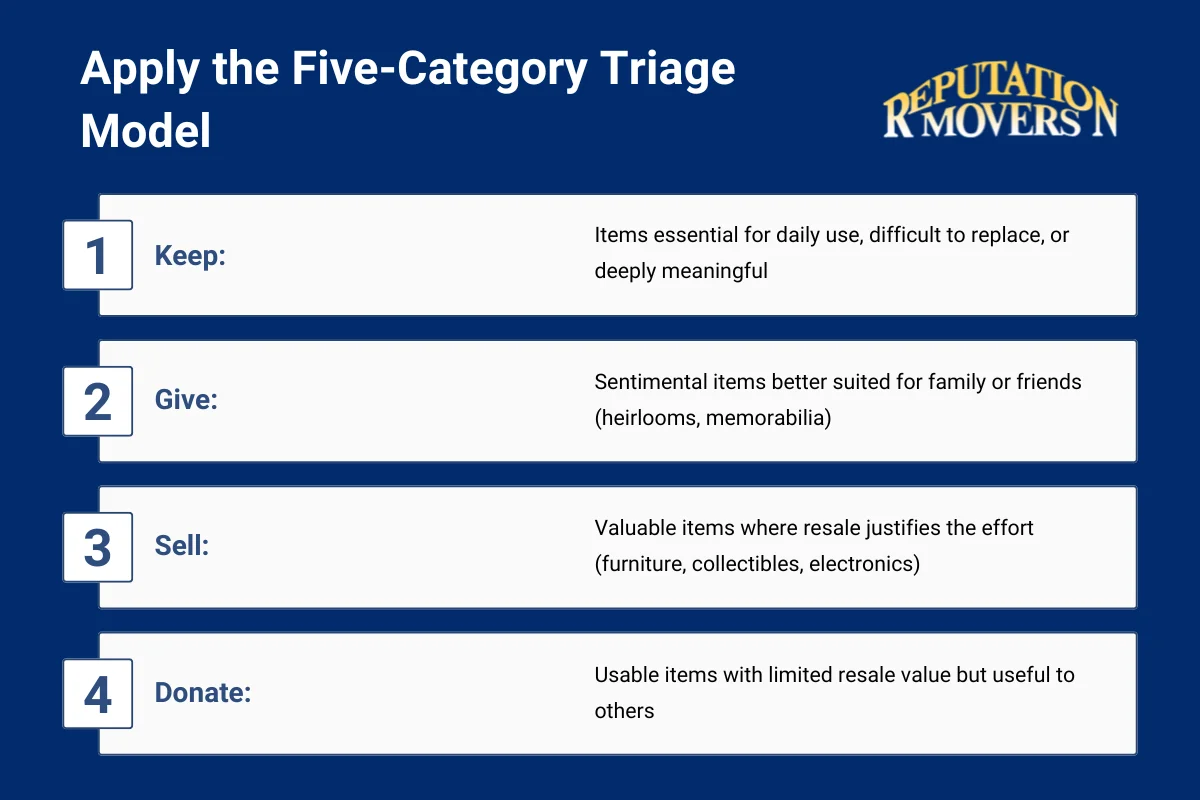
Before you pack, consider using a simple framework. The goal is to reduce decision fatigue, not rush through memories. Give yourself enough time to make thoughtful choices without turning every item into a separate project.
Keep what supports daily life now. Prioritize furniture, clothing, kitchen items, documents, and personal belongings that you use regularly or expect to use in the new home.
Pass on meaningful family items early. If heirlooms, photos, furniture, or keepsakes may matter to adult children or relatives, discuss them before moving deadlines create pressure.
Donate or sell items that no longer fit. Large dining sets, extra bedroom furniture, yard equipment, and duplicate household goods may not belong in a smaller home.
Use storage when decisions need more time. Short-term storage can create breathing room for items that require family discussion or a slower emotional decision.
Furniture planning prevents the new home from feeling crowded
One common downsizing mistake is moving too much furniture. Pieces that fit comfortably in a large detached home may overwhelm a condo, apartment, or townhouse. Oversized sectionals, formal dining sets, extra bedroom furniture, and large storage pieces can make the new space feel cramped.
Measuring before the move helps. Review the new floor plan, think about traffic flow, and decide which pieces will make the home comfortable without crowding it. It is better to make those decisions before move day than to discover that beloved furniture does not fit through a hallway or leaves no room to move around.
This is especially important in urban or compact living settings in Arlington and Alexandria, where smaller floor plans may offer great access to amenities but less room for furniture from a larger house.

A practical downsizing plan helps protect time, budget, and peace of mind
Downsizing is easiest when the process is broken into stages. Empty nesters who wait until the last moment often face rushed decisions, crowded packing days, and expensive last-minute problem solving. A calmer process starts earlier.
The first step is defining what you want the move to accomplish. Maybe the priority is fewer stairs. Maybe it is lower maintenance. Maybe it is living closer to family, reducing expenses, or freeing time for travel. Clear priorities make every later decision easier.
Once the goal is clear, the practical work can follow. This includes evaluating the new home’s size, deciding what furniture fits, sorting belongings, arranging packing, planning storage if needed, and coordinating move-day logistics.
A thoughtful downsizing move usually includes several connected decisions
Each choice affects the next. The size of the new home affects what furniture should come. The furniture plan affects packing. The packing plan affects whether storage is needed. The moving timeline affects how quickly decisions must be made.
Keeping these pieces connected can reduce stress and help avoid paying to move items you will later donate, sell, or store. It also helps the new home feel settled sooner.
As you prepare, focus on decisions that have the biggest impact on comfort and cost. These are the areas most likely to shape whether the move feels like a burden or a fresh start.
Choose the lifestyle goal first. Decide whether the move is mainly about less maintenance, fewer stairs, lower costs, closer family connections, or more flexibility.
Match belongings to the new floor plan. Use the size and layout of the next home to guide furniture, storage, and donation decisions.
Plan for emotional items separately. Family photos, heirlooms, children’s belongings, and career keepsakes may need more time than everyday household goods.
Avoid moving items by default. If something does not fit the next home or lifestyle, decide whether to sell, donate, pass it on, discard it, or store it temporarily.
Build in help for physical tasks. Packing, lifting, carrying, and furniture assembly can be physically demanding, especially when moving out of a multi-level home.
Downsizing can make the next chapter feel lighter and more manageable
The strongest reasons to downsize your home are often practical and personal at the same time. Less maintenance means fewer chores. Fewer stairs can make daily life easier. Lower costs can create more budget flexibility. A better location can bring family, friends, amenities, and community closer.
For empty nesters in Fairfax, Arlington, and Alexandria, downsizing is not about giving up the family home’s meaning. It is about choosing a home that supports the life you are living now. The memories remain, but the daily burden of maintaining more space than you need can be reduced.
If you are preparing to right-size, Reputation Movers can help with local moving, long-distance moving, packing and unpacking, storage, furniture assembly and staging, and home organizing. To get started, Get a Quote or call (703) 660-6683.



















.webp)


.webp)
.webp)
.webp)

.webp)
.webp)










.webp)

.webp)


.png)