.webp)
.svg)
China, crystal, and fragile kitchenware need more than a few sheets of paper and a standard moving box. The safest packing method uses the right box, enough cushioning, careful wrapping, correct item orientation, and clear labeling so every piece stays protected from pressure, vibration, and impact.
This guide explains how to pack china for moving, including step-by-step methods for plates, bowls, cups, crystal stemware, serving pieces, and fragile decor. It also explains when it makes sense to pack everyday dishes yourself and hire professional packers for the heirloom or high-value items that matter most.
At Reputation Movers, we help homeowners, renters, and families throughout Alexandria, Northern Virginia, and the greater DMV area with local moving, long-distance moving, packing, unpacking, storage, and related relocation services. If you have questions about fragile kitchenware before your move, you can reach us at (703) 660-6683.
The Best Materials for Packing China Start With Heavy-Duty Dish Boxes
The most important choice is the box itself. Professional movers consistently recommend heavy-duty, double-walled dish pack boxes for china, crystal, and fragile kitchenware. These boxes are thicker and more rigid than standard cartons, which helps them hold their shape when stacked in a truck or storage unit.
Dish pack boxes are designed for dishes and glassware. They distribute impact more evenly and are less likely to crush under pressure. That matters for both local and long-distance moves, especially when boxes may be lifted, stacked, shifted, or stored before they reach the new kitchen.
Home improvement and moving supply retailers also sell dish saver kits with foam pouches and cell dividers that fit inside specialized kitchen boxes. These kits can be helpful when packing plates, bowls, glasses, and fragile decor that should not touch during transport. The right materials do not guarantee safety by themselves, but they give your wrapping and cushioning a much stronger foundation.
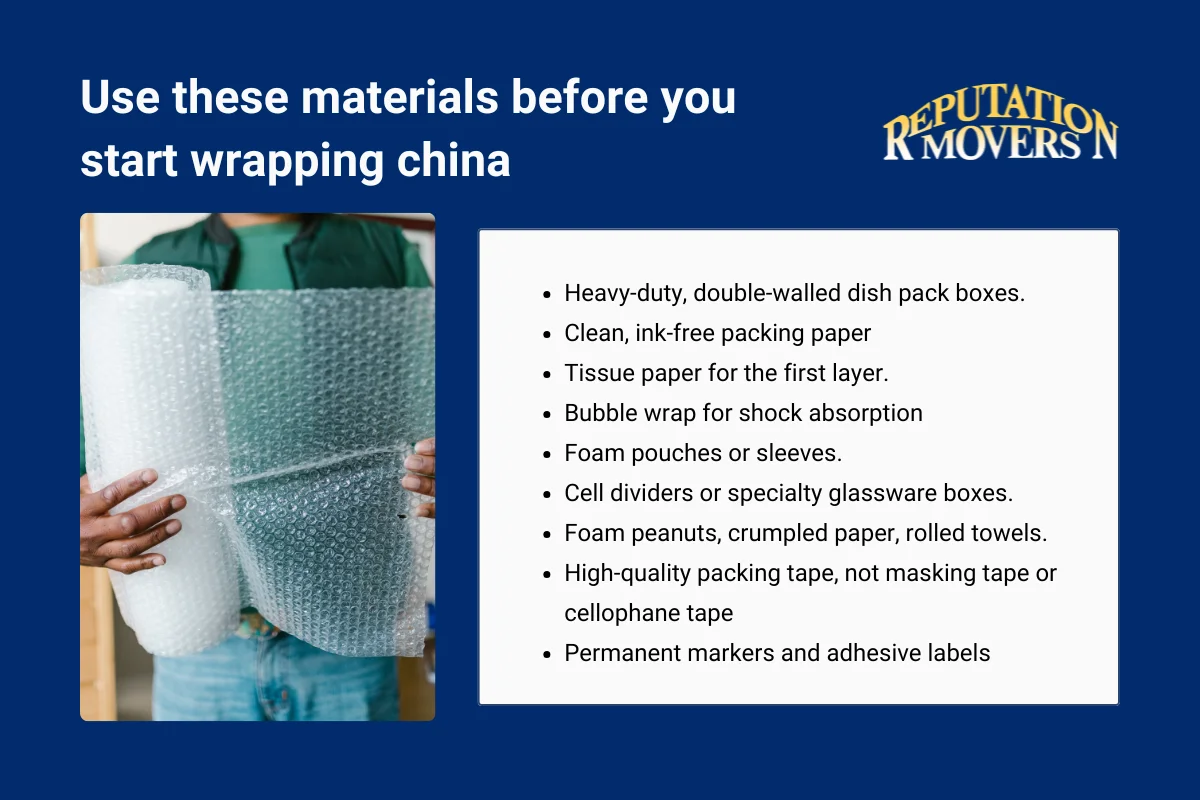
Use these materials before you start wrapping china
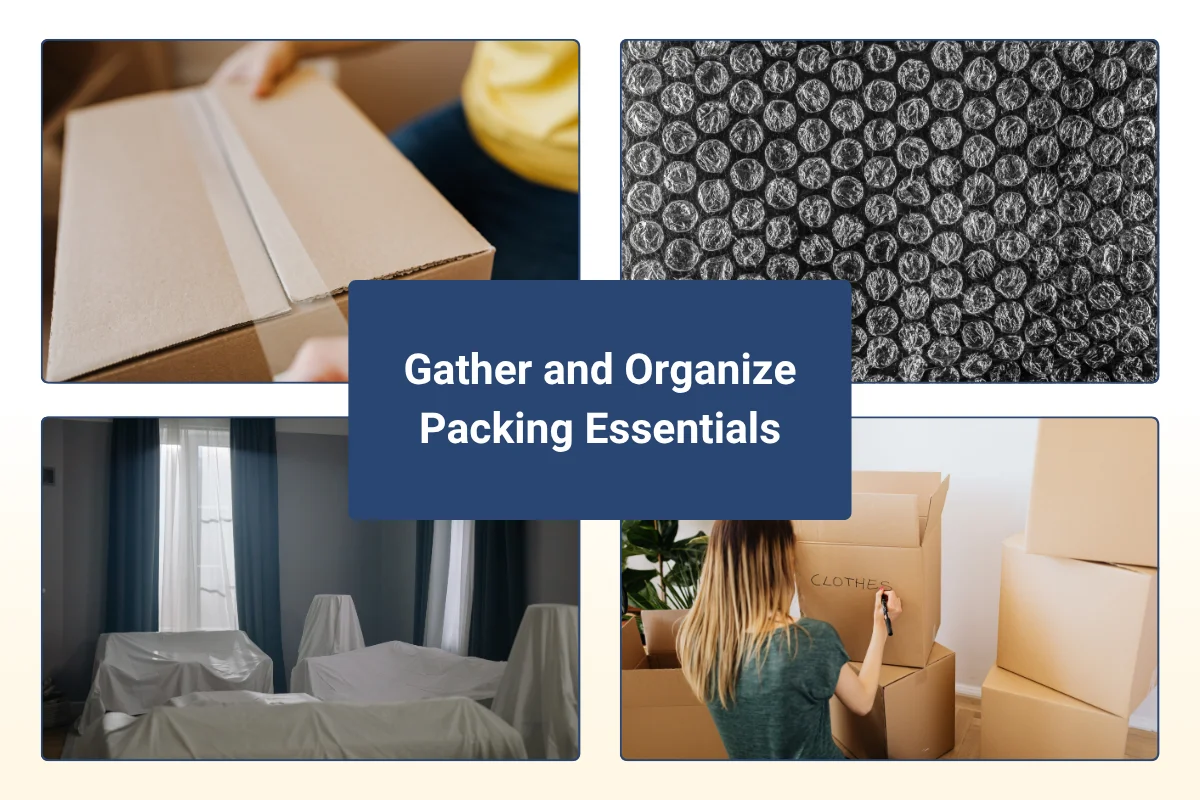
Gathering materials before you begin prevents rushed packing. Rushed work often leads to skipped wrapping layers, underfilled boxes, and unclear labels. For fragile items, the goal is to create a system where every piece is wrapped, every gap is filled, and every box tells movers exactly how it should be handled.
You do not need every specialty product for every dish. Everyday plates and bowls can often be packed safely with strong dish boxes, clean packing paper, and bubble wrap. High-value, heirloom, antique, or delicate pieces should get extra layers and, in some cases, specialty dividers or double-boxing.
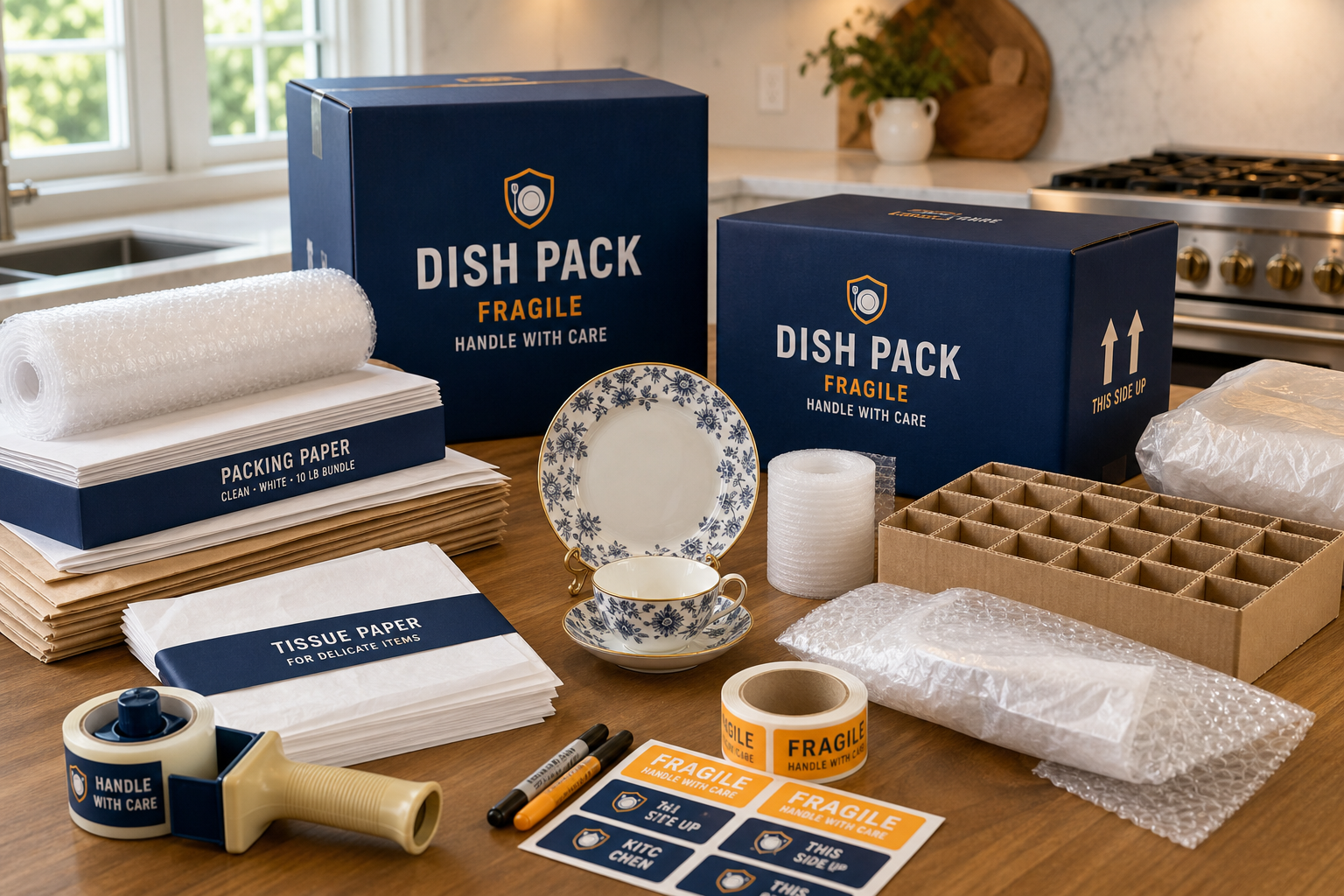
The key takeaway is simple: clean paper protects surfaces, bubble wrap absorbs shock, dividers prevent contact, and strong boxes keep the structure intact. Avoid improvising with weak cartons or dirty paper when packing china that would be difficult to replace.
Heavy-duty, double-walled dish pack boxes or kitchen moving boxes
Clean, ink-free packing paper
Tissue paper for the first layer on delicate finishes
Bubble wrap for shock absorption
Foam pouches or sleeves for plates, bowls, and glasses
Cell dividers or specialty glassware boxes for stemware and cups
Foam peanuts, crumpled paper, rolled towels, or soft textiles for box cushioning
High-quality packing tape, not masking tape or cellophane tape
Permanent markers and adhesive labels
Clean, ink-free packing paper is important because newspaper can smudge, stain, or transfer ink onto china glazes and crystal surfaces, especially in humid conditions. Bubble wrap should be used as an outer layer, particularly for delicate or valuable pieces. Tissue paper can be used first against fine finishes before adding packing paper and bubble wrap.
How to Build a Dish Box Before Any China Goes Inside
A dish box should be fully assembled and reinforced before packing begins. Open the box completely, fold the flaps correctly, and tape the bottom seam. Then add extra strips of tape along the bottom edges where the sides meet the base.
This reinforcement helps prevent a box from failing under the weight of plates, platters, and serving pieces. China becomes heavy quickly, even when each piece feels manageable on its own. A weak bottom seam can lead to a blow-out during lifting.
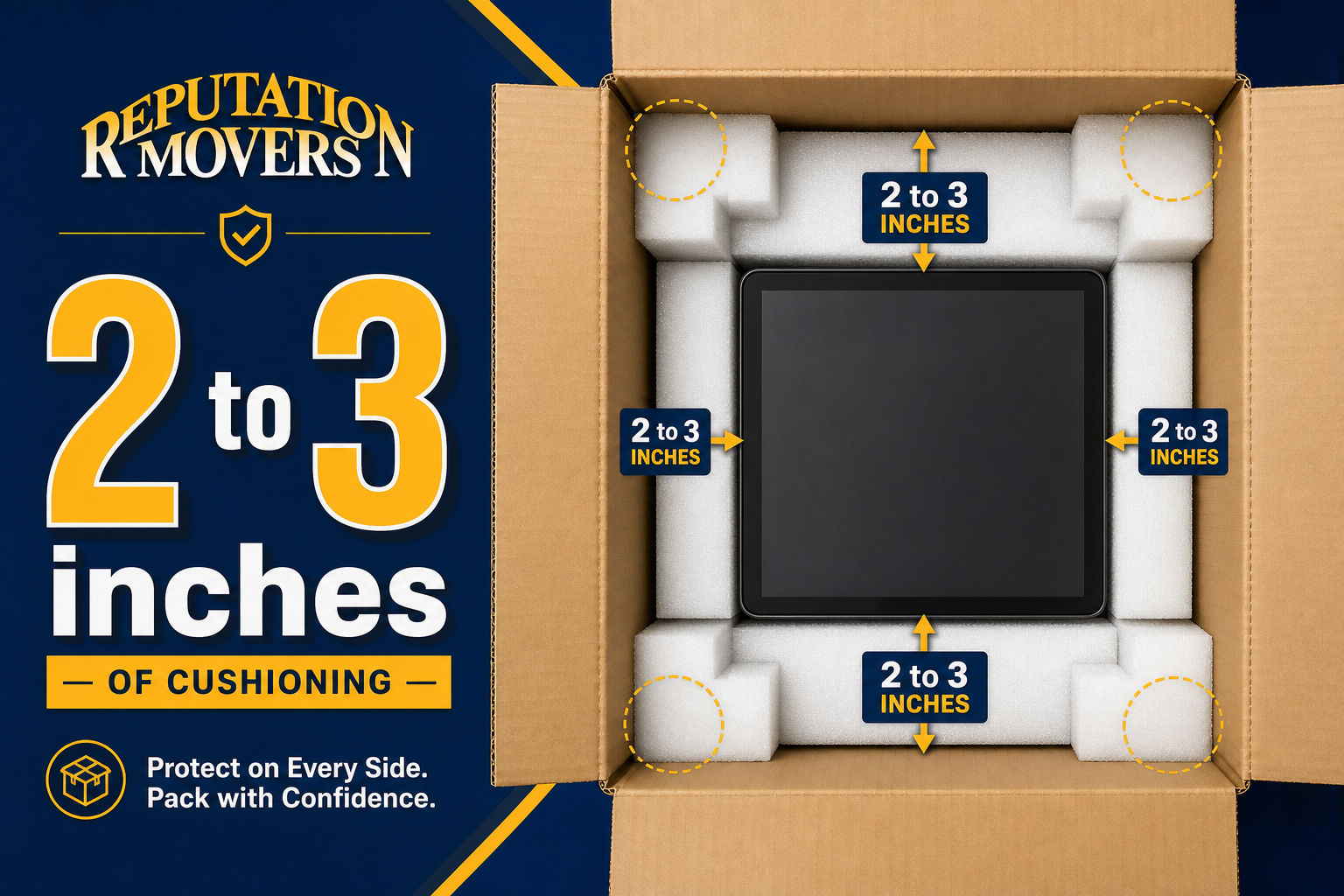
After the box is taped, create a shock-absorbing base. Several professional packing methods recommend a 3 to 6 inch layer of crumpled packing paper, bubble wrap, foam peanuts, or rolled towels at the bottom. This cushion absorbs vertical impact if the box is set down too quickly or encounters movement in transit.
Line the interior sides as well. Folded packing paper or strips of bubble wrap along the walls create a padded shell. This matters because side impacts can happen when boxes are carried through doorways, placed beside other cartons, or shifted inside a truck.
A simple dish box layout keeps fragile items separated
Think of the dish box in layers rather than as one deep container. Heavy and sturdy pieces go at the bottom. Lighter items go above them. Every layer gets its own cushion before the next layer begins.
The box should be snug, but not bulging. If the top flaps have to be forced closed, the box is overfilled. If the contents shift when the box is gently moved, more cushioning is needed.
Here is a simple text diagram for how to build the inside of the box:
Top layer: crumpled paper or bubble wrap that compresses slightly when closed
Upper item layer: cups, mugs, wrapped bowls, or stemware in dividers
Middle cushion: crumpled paper or bubble wrap between layers
Lower item layer: wrapped plates, platters, and sturdy serving pieces placed vertically
Side padding: folded paper or bubble wrap pressed along all interior walls
Bottom cushion: 3 to 6 inches of crumpled paper, bubble wrap, peanuts, or soft textiles
Once packed, seal the top with quality packing tape. Mark the top and at least two sides with “FRAGILE,” “HANDLE WITH CARE,” “THIS END UP,” and the contents, such as “CHINA,” “CRYSTAL STEMWARE,” or “KITCHEN DECOR.” Add the destination room so the box can be placed directly in the right area at delivery.
How to Pack China Plates So They Are Protected From Pressure Cracks
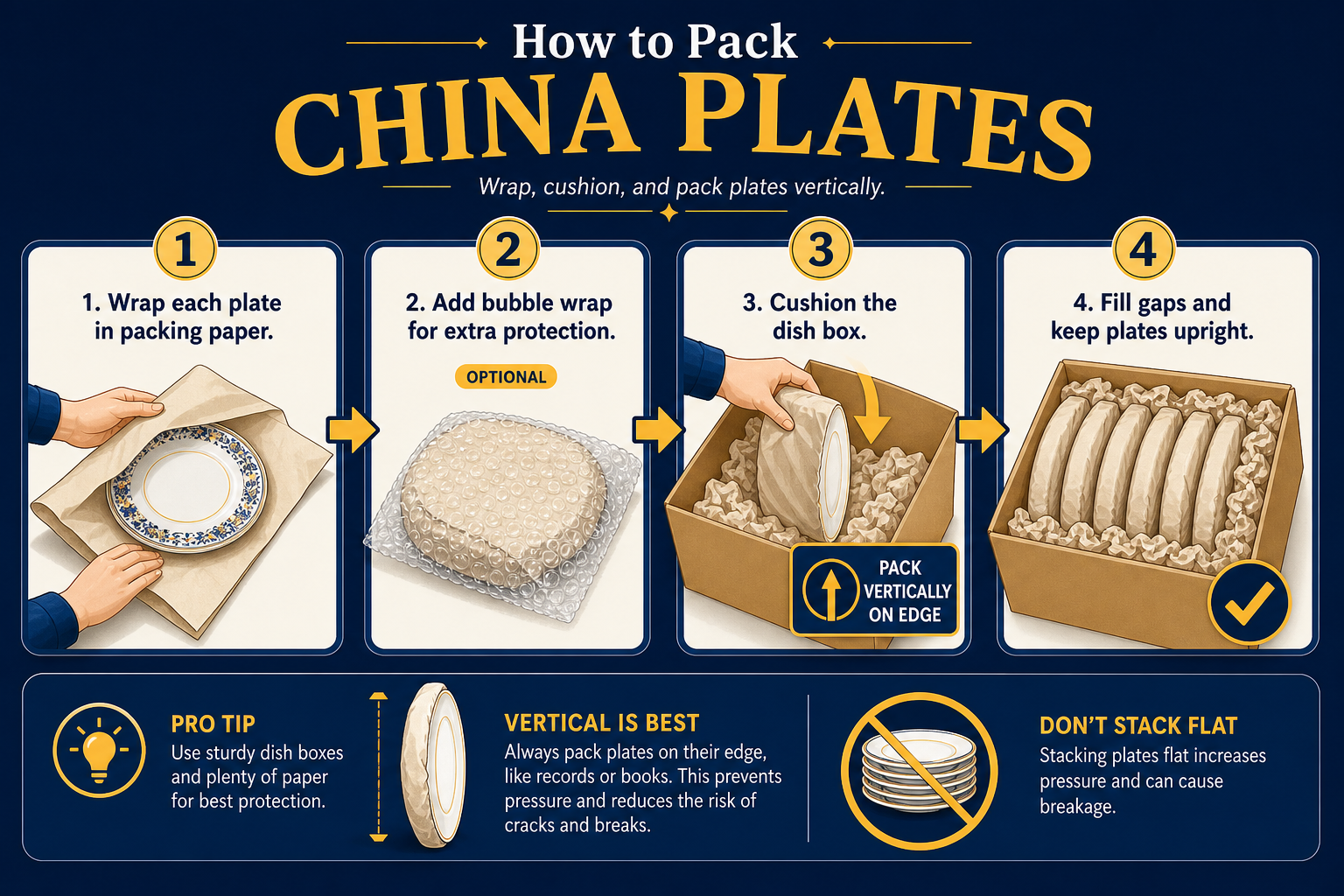
Plates are one of the most common fragile kitchen items, and they are also easy to pack incorrectly. The most repeated rule is to place plates vertically on their edges, not flat. A flat stack puts the weight of each plate on the plate beneath it, increasing the chance of cracks or chipped rims during impact.
When plates stand on edge, pressure is distributed differently and the bottom cushion can absorb movement more effectively. This is similar to the way records sit in a crate or dishes stand in a dishwasher. The method is simple, but the wrapping must be consistent.
Step-by-step method for wrapping china plates
Set up a flat, clean surface before you begin. Keep packing paper within reach and work one plate at a time. For especially delicate or heirloom china, add bubble wrap after the paper layer.
Some packing methods use individual wrapping for each plate. Others wrap small bundles with paper between every piece. Either way, the plates should not touch each other directly.
The safest approach is to use more paper than feels necessary. One professional packing guide in the research emphasizes that there is no such thing as too much packing paper when protecting fragile dishware.
Lay 2 to 3 sheets of clean packing paper on a flat surface.
Place one plate in the center of the paper.
Pull one corner of the paper up and over the plate, then tuck it around the dish.
Repeat with the remaining corners until the plate is fully covered.
Add another sheet if any surface feels exposed or lightly padded.
For delicate china, add an outer layer of bubble wrap and tape the wrap closed.
Place the wrapped plate vertically on its edge inside the cushioned dish box.
Pad tightly around the sides so the plate cannot slide or lean.
If you wrap a small bundle of plates, place paper between each plate before wrapping the group. Do not allow bare china surfaces to touch. Even a short move can create vibration and rubbing that leads to chips or hairline cracks.
How to Pack Bowls, Cups, and Mugs With Interior Cushioning
Bowls, cups, and mugs need protection on the outside and inside. Their rims, handles, and hollow spaces create stress points that should be supported before boxing. A wrapped exterior is not enough if the inside remains empty and unsupported.
For bowls, place the item face-up in the center of packing paper. Fold the paper edges into the center and secure the wrap. Then add crumpled paper inside the bowl to support the rim and reduce movement.
Nested bowls can be packed together, but only after each bowl is wrapped separately. Add padding between each one, place one inside the next, and wrap the nested group again. This prevents rubbing between surfaces.
Cups and mugs should receive extra attention around handles. Wrap the body, add extra paper around the handle, and keep handles facing the same direction when boxing. Many packing instructions recommend placing cups and mugs upside down, with no piece directly touching another.
A bowl and cup packing diagram helps prevent rubbing
The main idea is to avoid direct contact. If two pieces can touch, they can chip. If a hollow item is not supported inside, it can flex or crack under pressure.
Before closing the box, fill all gaps around bowls, cups, and mugs with crumpled paper, bubble wrap, or soft textiles. A properly packed box should not rattle when gently moved. If you hear movement, open the box and add more cushioning.
Use this layout as a guide for bowls and cups:
Bowl exterior: wrapped fully in packing paper
Bowl interior: filled with crumpled paper to support the rim
Nested bowls: paper between each bowl, then an outer wrap around the group
Cup or mug handle: reinforced with extra paper
Cups in box: placed upside down, with handles aligned
Open gaps: filled completely so nothing shifts
This same approach works for many fragile kitchen and decor items. Support hollow areas, wrap delicate edges, and keep each piece separated from the next.
How to Pack Crystal Stemware and Fragile Glassware
Crystal stemware and delicate glasses need extra protection because stems, rims, and bases are vulnerable. The best method uses several layers: tissue paper first, packing paper next, and bubble wrap outside for shock absorption. The inside of the glass should also be filled with crumpled paper, foam, or soft cloth.
Start by gently wrapping the glass in tissue paper. Then use packing paper, paying close attention to the stem and base. Add padding inside the bowl of the glass to support the thin walls.
After the paper layers are complete, wrap the piece in bubble wrap and tape it closed. The tape should secure the bubble wrap, not touch the crystal surface. For stemware, add extra cushioning around the stem before placing it in the box.
Cell dividers and specialty glassware boxes are especially useful for crystal. They isolate each item and reduce clinking or rubbing, which can cause hairline cracks. Glasses and cups are commonly packed upside down in rows, with no piece touching another.
At Reputation Movers, this is one of the most common places where clients choose a hybrid approach: they pack everyday kitchen items themselves, then ask us to pack delicate crystal, heirloom china, ornate serving pieces, and fragile decor with professional materials and methods.
How to Pack Serving Pieces, Platters, and Fragile Kitchen Decor
Serving pieces and platters often become the foundation layer in a dish box because they are larger and sturdier than cups or stemware. That does not mean they can be packed casually. Large china pieces and fragile glass plates should still be wrapped individually in multiple layers of paper and, when needed, bubble wrap.
Place platters and large serving pieces vertically on their edges rather than flat. This reduces pressure from weight above. Surround each piece with cushioning so it cannot slide, lean, or strike another item.
Irregularly shaped decor requires extra judgment. If a piece has handles, raised details, a lid, a narrow base, or delicate edges, those areas need extra padding. If the item is valuable or especially fragile, double-boxing may be appropriate.
Double-boxing protects high-value or irregularly shaped pieces
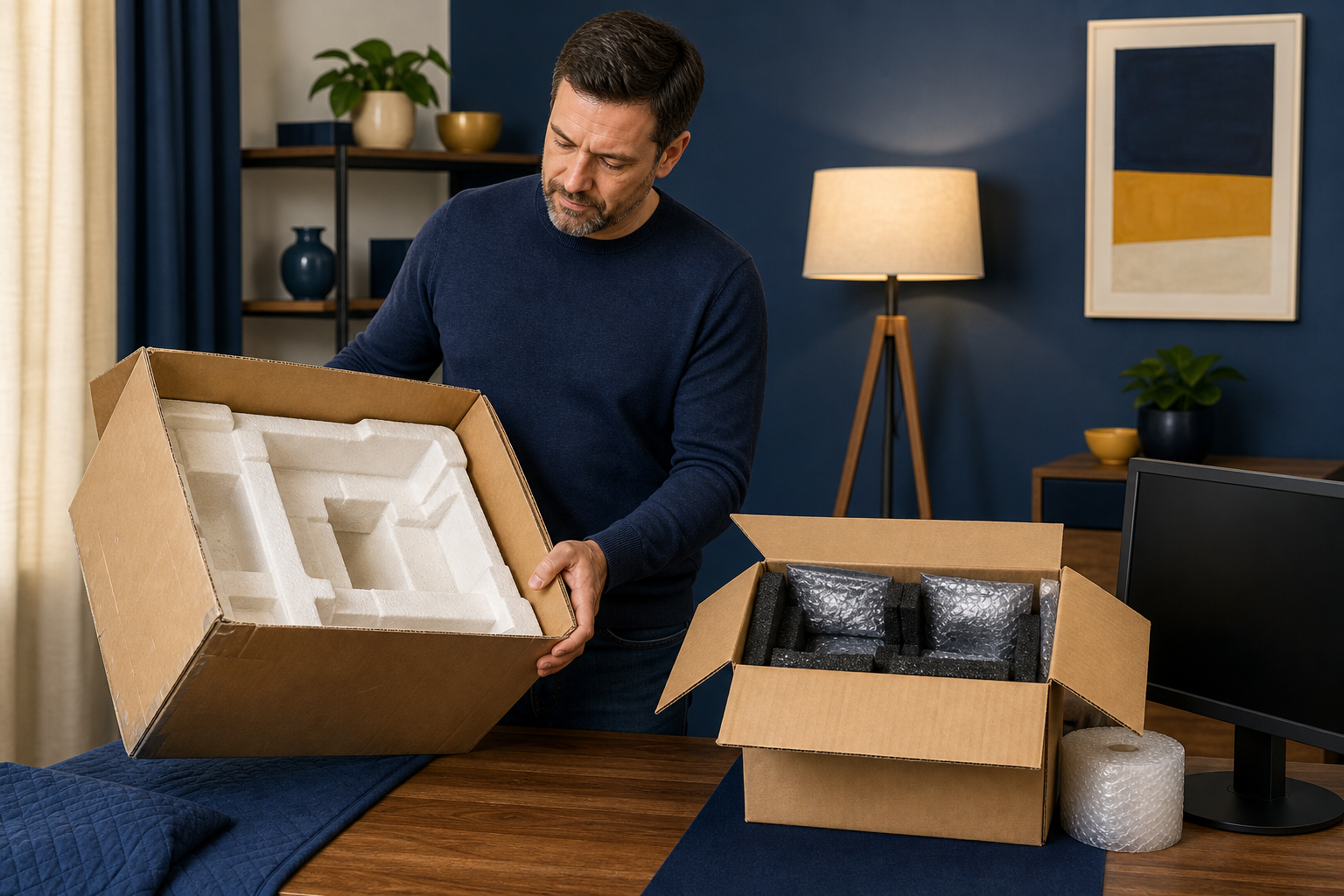
Double-boxing means packing the item inside a smaller, well-cushioned inner box, sealing that box, and then placing it inside a larger carton. The larger carton should have padding on every side, including top and bottom. The research recommends at least 3 inches of packing peanuts on all sides for very fine china or delicate decor.
This method creates a second protective barrier. It is useful when a single box does not provide enough structure or when the item has an unusual shape. It also helps isolate fragile decor from heavier kitchenware.
Double-boxing takes more time and materials, so it is not usually necessary for every everyday dish. Reserve it for heirloom china, antique crystal, rare decor, and pieces that would be difficult or impossible to replace.
Common China Packing Mistakes That Lead to Chips and Breaks
Most china damage comes from a few preventable mistakes. The items may be fragile, but the real risk often comes from movement inside the box, pressure from poor stacking, weak materials, or unclear labeling. Careful packing reduces those risks before the box ever reaches the truck.
The biggest mistake is failing to wrap each item separately. Plates and bowls may nest neatly in a cabinet, but they should not be packed bare against each other. One bump can cause them to crash together, chip, or crack.
Another major mistake is leaving empty space. Gaps become impact points as the truck moves. For long-distance moves, vibration and jolting over many miles can make even small empty spaces dangerous for fragile items.
Avoid these high-risk packing errors
It is tempting to save time or materials when packing a kitchen. China and crystal do not respond well to shortcuts. Every item should be immobilized, every box should be reinforced, and every label should be easy to read.
Oversized boxes are another problem. Large cartons encourage overpacking, which makes the box too heavy and harder to carry safely. Heavy boxes are more likely to be dropped, crushed, or mishandled, and oversized boxes can flex under pressure.
Professional guides often suggest keeping dish box weights under roughly 40 pounds. If a box feels too heavy to lift with control, it is too heavy for fragile china.
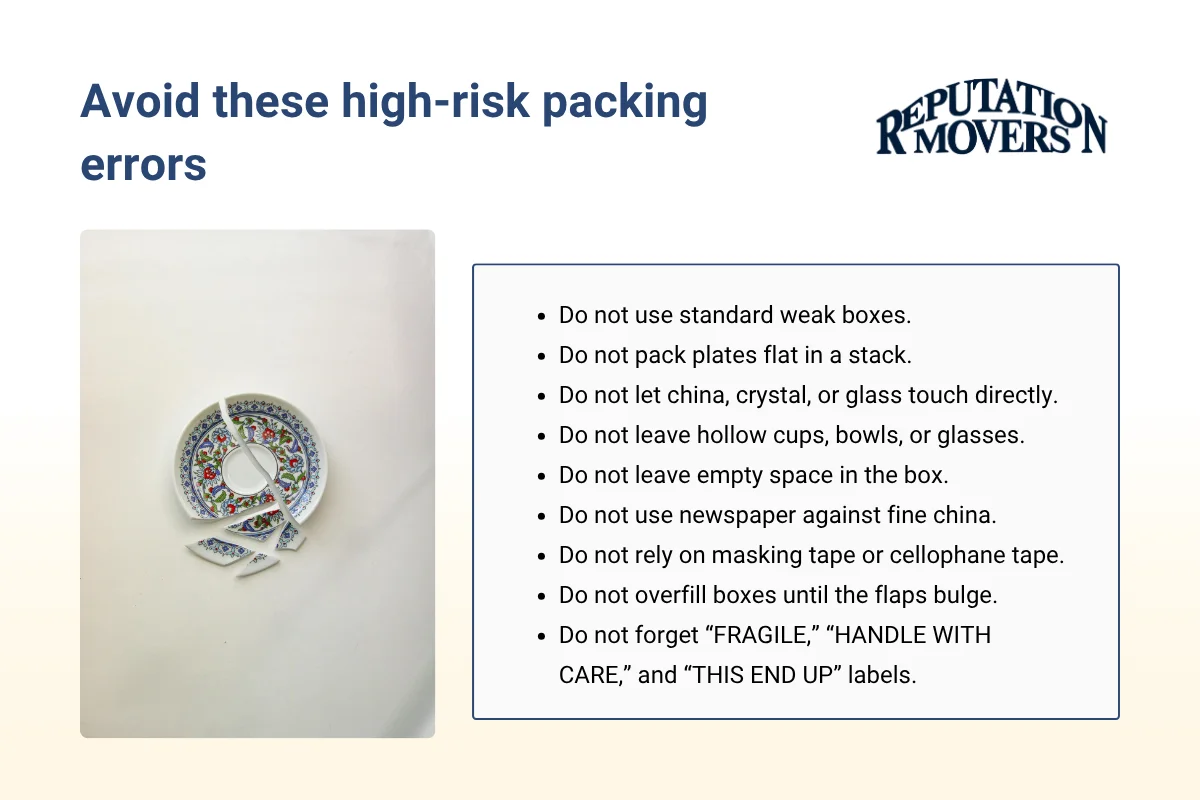
Do not use standard weak boxes when heavy-duty dish packs are available.
Do not pack plates flat in a stack without vertical orientation.
Do not let china, crystal, or glass touch directly.
Do not leave hollow cups, bowls, or glasses unsupported inside.
Do not leave empty space in the box.
Do not use newspaper against fine china or crystal surfaces.
Do not rely on masking tape or cellophane tape.
Do not overfill boxes until the flaps bulge.
Do not forget “FRAGILE,” “HANDLE WITH CARE,” and “THIS END UP” labels.
The Home Depot packing guidance also emphasizes wrapping dishes and filling gaps so items do not shift during a move. Movement inside the box is one of the easiest risks to overlook, and one of the most important to eliminate.
Labeling China Boxes Helps Movers Stack and Handle Them Correctly
Labels are not just reminders for unpacking. They help movers decide where a box belongs in the truck, how it should be stacked, and which side should stay upright. A dish box with clear labels is less likely to be placed beneath heavy cartons or turned in the wrong direction.
Mark each box on the top and at least two sides. If only the top is labeled, the warning may be hidden when boxes are stacked. Large, clear writing with a permanent marker is best.
Use labels such as “FRAGILE,” “HANDLE WITH CARE,” and “THIS END UP.” Then add specific contents, such as “CHINA PLATES,” “CRYSTAL STEMWARE,” “SERVING PIECES,” or “KITCHEN DECOR.” Include the destination room, such as “KITCHEN” or “DINING ROOM,” so the box can be placed correctly at delivery.
A numbered inventory can also help, especially if only some fragile items are professionally packed. For example, you might label boxes “Kitchen Fragile 1,” “Kitchen Fragile 2,” and “Crystal 1,” then keep a simple list of what each box contains. This makes unpacking easier and helps distinguish homeowner-packed boxes from professionally packed boxes.
When It Makes Sense to Hire Professional Packers for China Only
Many homeowners can safely pack everyday dishes by following careful methods. The decision changes when the items are valuable, sentimental, antique, delicate, or difficult to replace. In those cases, professional packing can be a practical way to reduce risk without outsourcing the entire home.
Professional packers bring specialized training, materials, and experience. Moving advice sites note that professional packing services are associated with efficiency, safety, and successful outcomes, especially for fragile or high-value items. The Thumbtack packing services guide identifies packing services as a resource for people who need help protecting belongings before a move.
A hybrid approach often works well. You can pack clothing, books, pantry goods, and everyday dishes yourself, then reserve professional packing for heirloom china, antique crystal, rare decor, and delicate serving pieces. This gives the most vulnerable items expert attention while keeping the overall move manageable.
Professional packing is especially useful in these situations
Some fragile items need more than standard wrapping. Existing hairline cracks, ornate details, thin stems, or unusual shapes can make an item harder to protect. Long-distance moves also add handling, vibration, and time in transit.
Time pressure is another factor. Packing in a hurry often leads to skipped layers, weak cushioning, and unclear labeling. If moving day is close and the fragile kitchenware is still in cabinets, professional help can prevent rushed decisions.
Before professional packers arrive, homeowners can make the process easier by cleaning and organizing items, discarding what they do not need, and clearly identifying high-value belongings. This helps ensure the most important pieces receive the right level of care.
Heirloom china with sentimental value
Antique crystal or delicate stemware
Rare decor or irregularly shaped fragile pieces
Large serving platters and high-end serving pieces
Items with existing chips, cracks, or delicate rims
Fragile items going into short-term or long-term storage
Long-distance moves where boxes may be handled multiple times
Moves with tight timelines where careful packing may be rushed
Professional packing can also support risk management. When professionals pack fragile items using industry-standard methods and materials, damage claims may be mor
e straightforward than when a self-packed box fails because it was oversized, under-padded, or poorly taped.
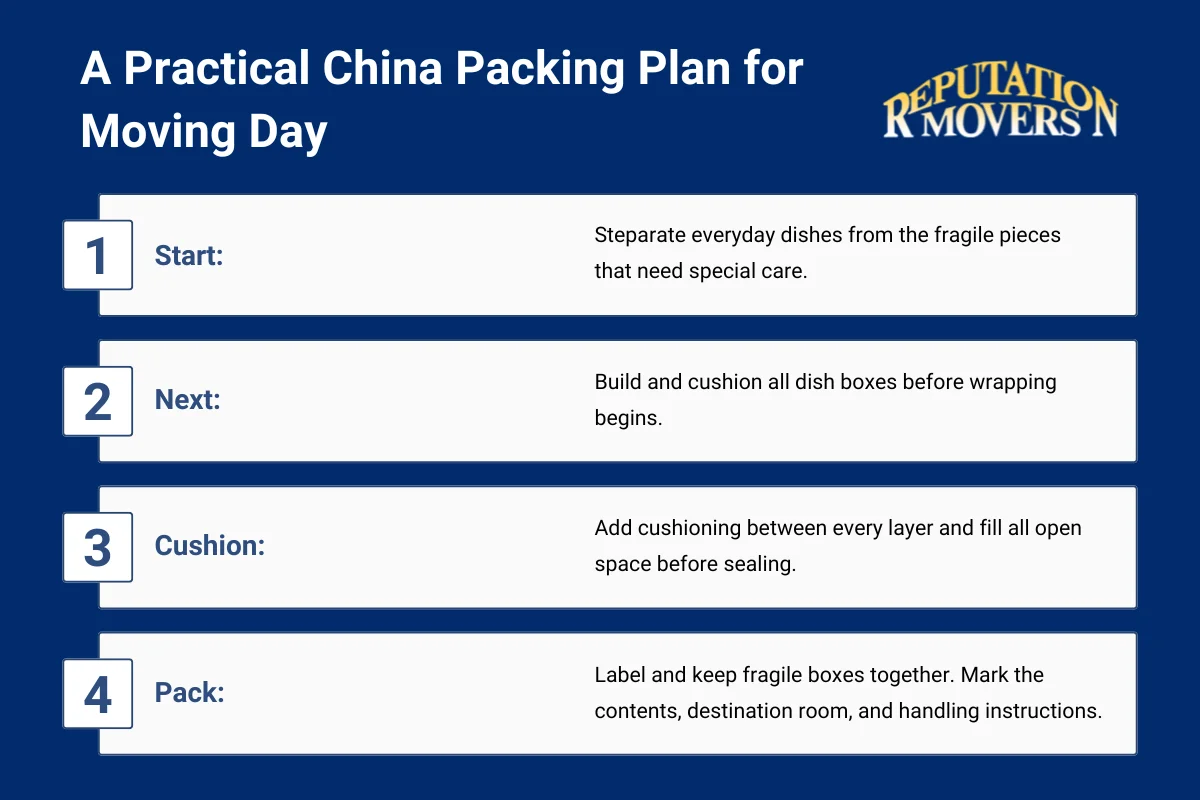
A Practical China Packing Plan for Moving Day
Start by separating everyday dishes from the fragile pieces that need special care. This keeps the process organized and helps you decide what to pack yourself and what to set aside for professionals. It also prevents fragile pieces from being mixed into general kitchen boxes.
Next, build and cushion all dish boxes before wrapping begins. Reinforce the bottom, line the sides, and create a thick base layer. Then wrap plates, bowls, cups, stemware, and serving pieces according to their shape and fragility.
Pack in layers. Put sturdy, heavier wrapped pieces at the bottom, lighter items above, and delicate crystal or glassware in protected rows with dividers when possible. Add cushioning between every layer and fill all open space before sealing.
Before taping the box shut, perform a gentle movement check. If anything shifts, add more paper, bubble wrap, or soft textiles. A snug box is safer than a loose one, but the flaps should still close flat without bulging.
Finally, label clearly and keep fragile boxes together. Mark the contents, destination room, and handling instructions. If some items were professionally packed and others were self-packed, note that clearly on your inventory.
Get a Quote for Fragile Packing and Moving Help in Northern Virginia
Packing china for moving takes patience, the right materials, and careful attention to orientation, cushioning, and labeling. If you want to handle most of your packing yourself but would rather have professionals pack the fragile kitchenware, crystal, heirloom china, or decor, Reputation Movers can help with that part of the move.
To get help with packing, moving, storage, or related relocation services in Alexandria and Northern Virginia, contact Reputation Movers and Get a Quote. Call (703) 660-6683 or Complete our Request Form.













.webp)
.webp)
.webp)
.webp)

.webp)
.webp)






.webp)
.webp)


.png)