.webp)
.svg)
Moving a treadmill looks simple until the first doorway, stair landing, or tight hallway turn. The machine may have wheels, and it may even fold, but its weight, width, motor-heavy frame, and electronics make it one of the more difficult items in a residential move.
For many homeowners, the hardest part is not the distance from one home to another. It is getting the treadmill out of the exercise room, down the stairs, through the door, into the vehicle, and set up again without scraping walls, cracking trim, pinching wires, or injuring someone.
Reputation Movers helps homeowners and renters in Alexandria, Northern Virginia, and the greater DMV area with residential moves that include difficult specialty items like treadmills, home gym equipment, and heavy furniture. If you have questions about whether your treadmill should be disassembled, moved intact, or handled separately from the rest of a small local move, you can reach out to us for guidance.
Most Treadmills Are Too Heavy and Awkward for a One-Person Move
A treadmill is not just a long piece of furniture. Its weight is uneven, its frame is awkward to grip, and its most fragile parts are often the same parts that stick out in tight spaces. That combination is what makes treadmill moving risky.
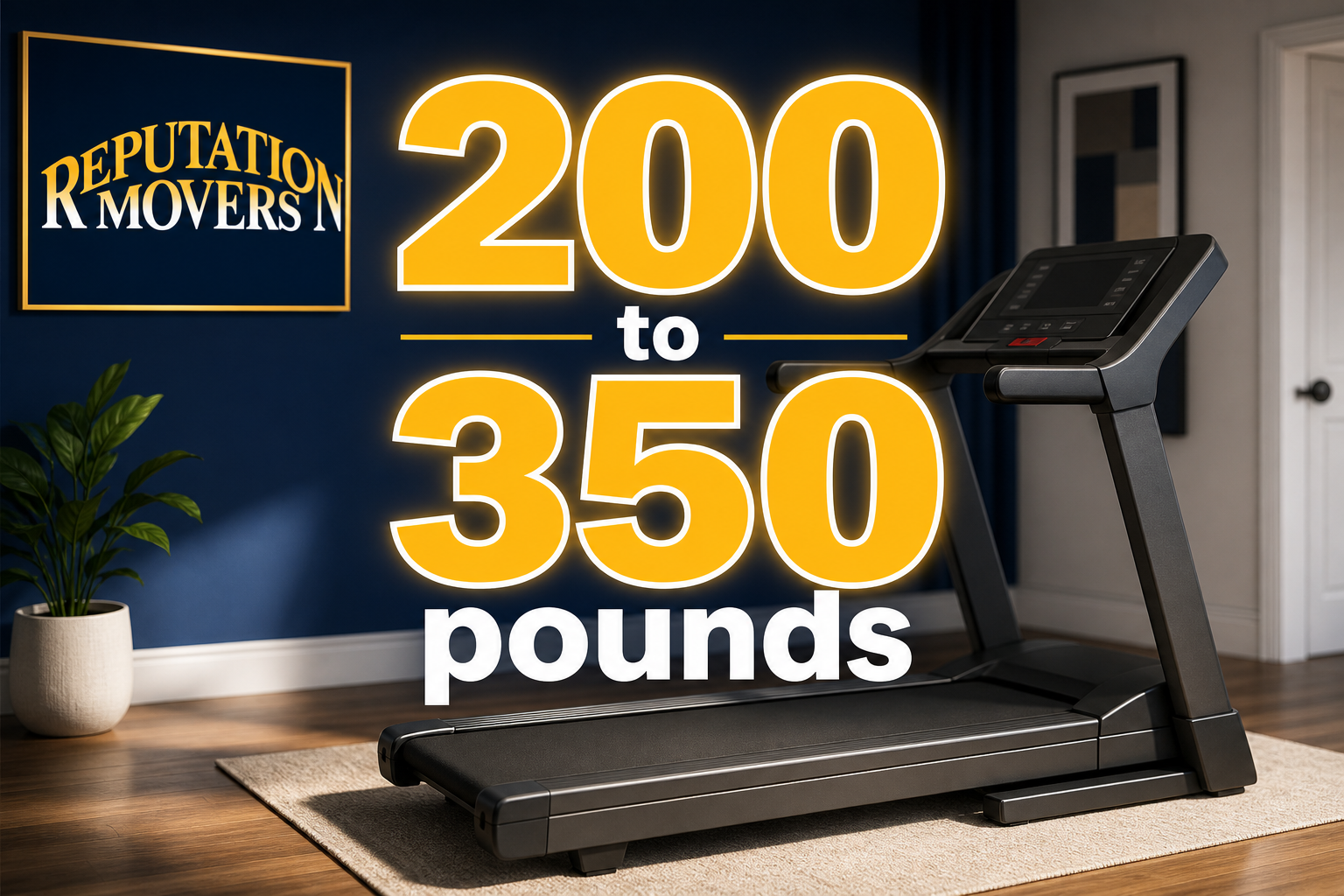
Home treadmills typically weigh between 200 and 350 pounds, while budget models may be closer to 150 to 200 pounds. Many commercial-grade units reach 290 to 400 pounds or more, and some large gym-style models can weigh up to 500 to 590 pounds.
The weight is also not evenly distributed. The motor end, usually at the front of the treadmill, is significantly heavier. That means one side is harder to lift, harder to pivot, and harder to control on stairs.
Because of that concentrated weight, moving a treadmill is less like carrying a sofa and more like handling a heavy appliance with a delicate console attached. Even if the total distance is short, the risk increases quickly when stairs or narrow turns are involved.
A Folding Treadmill Is Smaller, but It Is Not Always Narrower
Many homeowners assume a folding treadmill will fit through the house once the deck is raised. Folding does help, but it does not solve every clearance problem. A folding mechanism usually reduces length, not width.
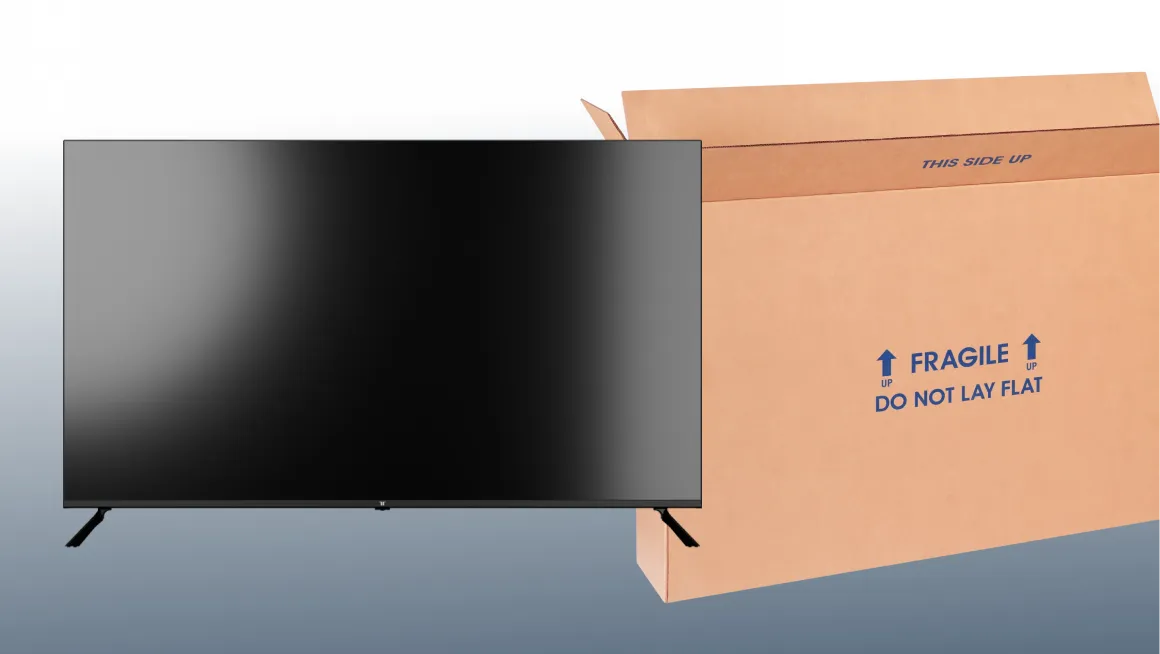
A full-size home treadmill is often 64 to 84 inches long, 28 to 40 inches wide, and 55 to 65 inches high when assembled. Many folding models reduce their length by 30 to 40% when upright, but the console, arms, and handrails may still be just as wide.
That matters because standard residential doorways are often 30 to 32 inches wide, while newer or upgraded openings may be closer to 36 inches. If the treadmill’s widest point is 35 to 40 inches because of the console or handrails, folding alone may not get it through the door.
Before planning the move, check the owner’s manual or manufacturer’s specifications. The manual may list assembled weight, folded dimensions, and model-specific disassembly guidance. For a treadmill, the model number is not a minor detail. It can determine whether the machine can be rolled, folded, partially disassembled, or taken apart more extensively.
Measure the Treadmill and the Entire Route Before Anyone Lifts It
The safest treadmill move starts with measurements, not muscle. A measurement-first plan helps you decide whether the treadmill can move intact, whether parts need to come off, and whether stairs create too much risk for a DIY attempt.
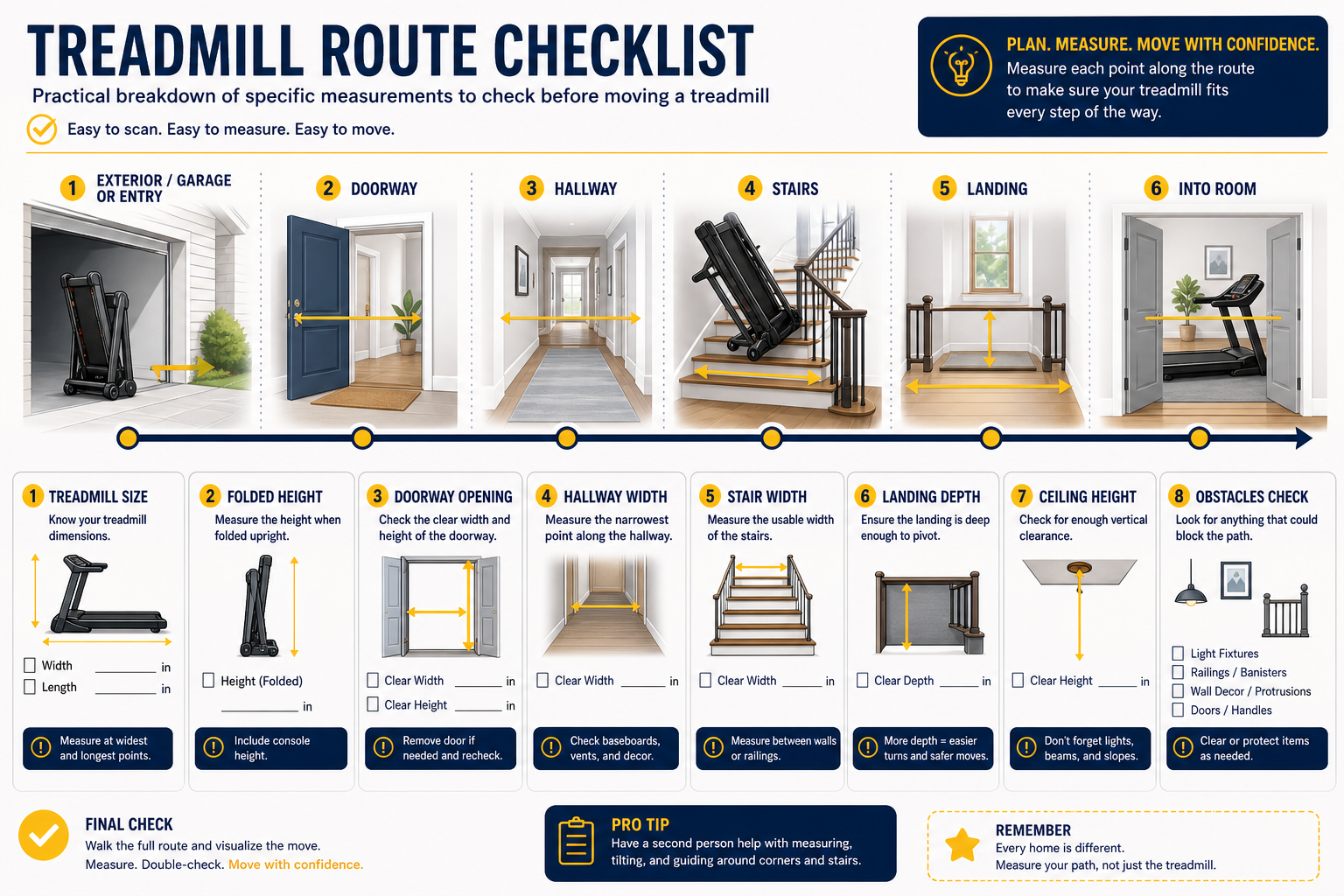
Measure the treadmill in the most compact transport position. That may mean folded upright, partially disassembled, or both. The widest point is often not the deck. It may be the handrails, console housing, or upper frame.
Then measure every part of the route. A treadmill that clears the bedroom doorway may still fail at a hallway turn, stair landing, or low ceiling. The issue is not only whether the machine fits straight through an opening, but whether it can pivot safely without hitting walls, railings, fixtures, or trim.
Many moving guides recommend comparing the treadmill’s folded or disassembled dimensions against every doorway, hallway, stairwell, and turn along the path, because treadmill fit depends on doors, stairs, and turns, not room size alone.
Measure These Clearance Points Before Moving a Treadmill
A few careful measurements can prevent the most common treadmill-moving problems. This is especially important in townhomes, condos, basements, and older homes where stairs and interior doorways can be narrow. The goal is to identify hard stops before the treadmill is already tilted, strapped, and halfway through a doorway.
Use the treadmill’s most compact moving position when comparing measurements. If you plan to remove the console, handrails, or uprights, measure again after those parts are off. A one-inch mistake can be enough to scrape trim or trap the treadmill in a turn.
Leave a margin where possible. Having 1 to 2 inches of clearance on each side is often recommended when rolling or pivoting a treadmill through a doorway. If the fit is exact, the risk of cosmetic damage rises.
Measure the treadmill at its widest point, usually the console or handrail span.
Measure the treadmill length both unfolded and folded.
Measure the height when folded, especially if it will travel upright.
Measure doorways between the actual clear openings, including trim.
Measure hallway width at the narrowest point.
Measure stair width between rails, walls, or trim.
Measure landing depth to confirm the treadmill can pivot.
Measure ceiling height at stairwells and landings.
Look for light fixtures, crown molding, wall hooks, shelves, and railings that reduce clearance.
Disassembly Becomes Necessary When Width, Turns, or Stairs Do Not Work
Disassembly is not always required, but it becomes necessary when the measured route does not match the treadmill’s actual dimensions. Trying to force the machine through a hard width mismatch is one of the fastest ways to damage the home or the treadmill.
A 36-inch-wide treadmill section cannot pass through a 32-inch opening just because it is tilted. Angling can help with length and turning radius, but it cannot overcome a fixed width problem. If the console, handrails, or frame exceed the clear opening, parts need to come off if the manual allows it.
Typical partial disassembly may include unplugging the unit, removing the safety key, removing accessories, and detaching handlebars, uprights, or the console assembly. Some larger or commercial-framed treadmills may need more extensive disassembly before they can move through residential doors and hallways.
This is where a small local move can become more complicated than expected. A homeowner may be able to handle boxes, lamps, and light furniture, but the treadmill still requires tools, padding, a clear plan, and careful reassembly. Reputation Movers is often brought in for this specific part of a move because a single treadmill can create the highest injury and damage risk in an otherwise simple relocation.
Follow the Manual Before Removing Console Parts or Frame Sections
The owner’s manual matters because treadmills vary by model. Some consoles and arms are designed to detach cleanly. Others may include wiring, hidden fasteners, or plastic covers that can crack if handled the wrong way.
Before removing parts, unplug the treadmill and make sure moving components are secure. If the treadmill has an incline feature, guidance recommends setting it to zero before movement. The safety key should also be removed so the machine cannot accidentally activate.
When disassembling, take photos at each step. Label wires with tape. Place screws, washers, and bolts in labeled bags or containers grouped by the section they came from. These simple steps reduce confusion when it is time to put the treadmill back together.
Improper disassembly can lead to pinched wires, non-functioning displays, misaligned handrails, squeaking belts, or incorrect bolt placement. If plastic housing needs to be removed, use care. Prying with the wrong tool can scratch or crack the treadmill even before it leaves the room.
Protect Floors, Door Frames, and Walls Before the Treadmill Moves
Most treadmill damage during a move is easy to understand after it happens. The wheels dig into wood. The motor end drops harder than expected. A handrail swings into the door frame. The console catches a corner. The problem is that by then, the wall, floor, or machine is already damaged.
Treadmills place a lot of weight on small feet, rollers, or wheels. Dragging one across a floor can dent hardwood, tear vinyl, crack tile, or leave permanent impressions in carpet padding. A protected path helps distribute that weight and makes the move smoother.
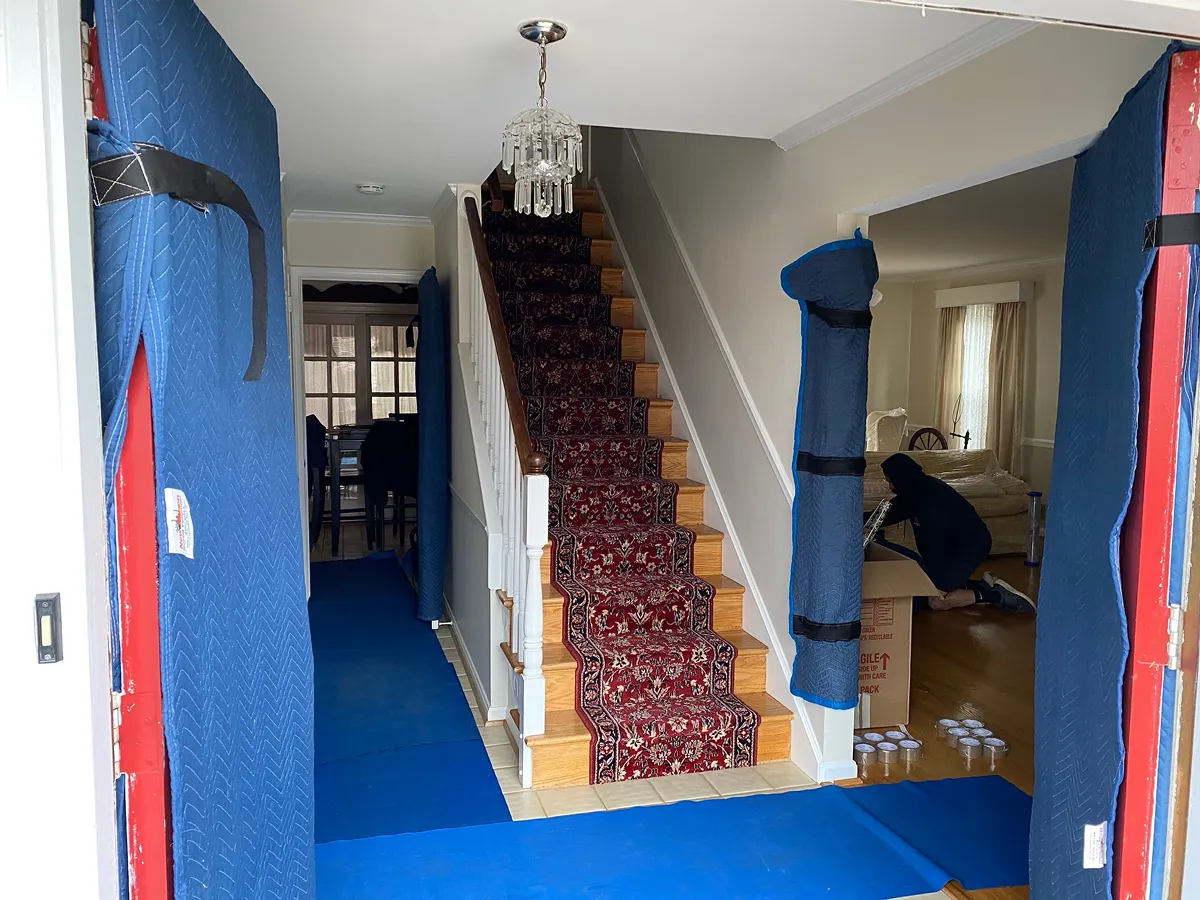
Moving blankets, dense cardboard, thin plywood sheets, and ram board-style floor protection can create a safer runway from the treadmill’s starting point to the exit. Overlap the edges so wheels or dollies do not catch. In renovated homes or homes with delicate finishes, this step is especially important.
Pad the Treadmill and the Home Surfaces It May Contact
The treadmill should not be the only thing protected. Door frames, hallway corners, low walls, and stair rail areas are frequent impact points during a treadmill move. Padding these areas reduces the chance that a small bump becomes a visible gouge or chip.
Painter’s tape is commonly recommended because it removes cleanly while holding temporary padding in place. Moving blankets, thick towels, foam padding, cardboard edge protectors, and padded door jamb protectors can all help shield vulnerable surfaces.
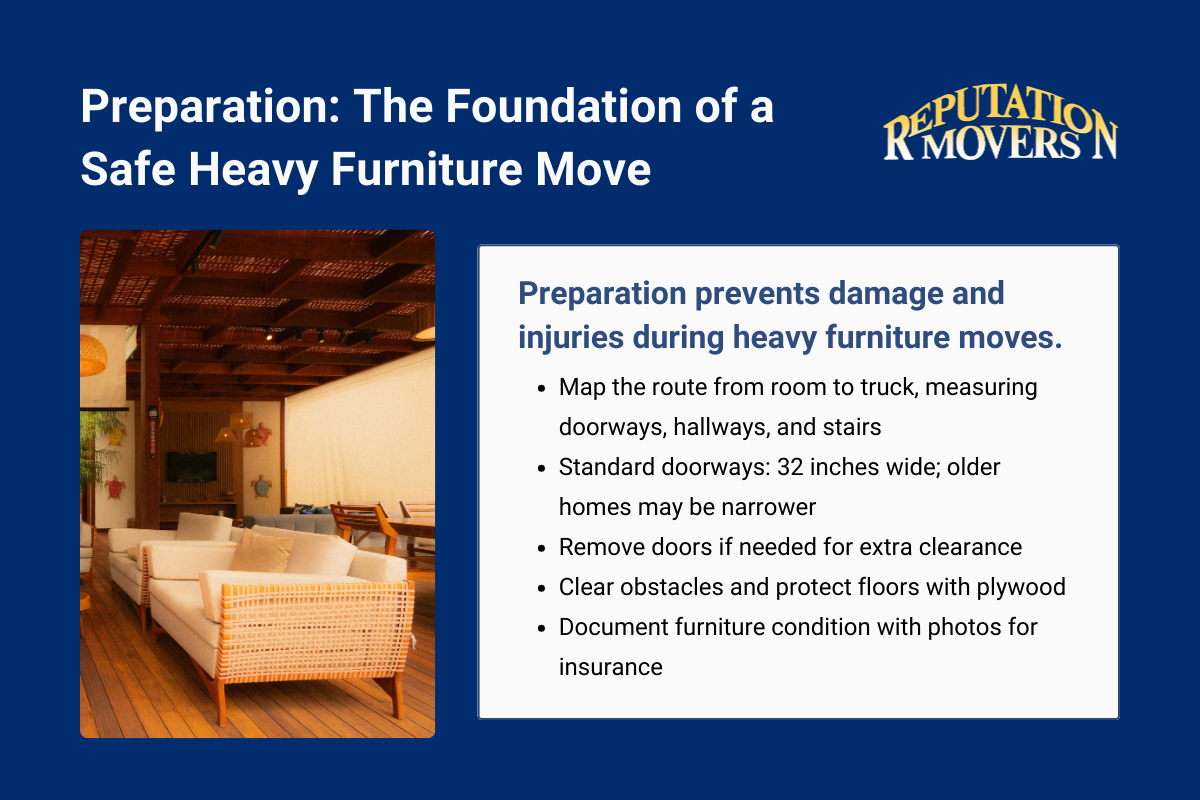
It is also important to clear the route before lifting begins. Remove rugs, doormats, loose cords, small tables, shoe racks, wall hooks, pictures, and anything else that could catch the treadmill or trip a handler. On stairs, confirm the handrails are secure and the steps are clear.
For tight openings, removing an interior door from its hinges may create an extra 2 to 3.5 inches of clearance. That can be enough to avoid scraping trim or forcing the machine through a doorway.
Stairs Are the Most Dangerous Part of Moving a Treadmill
If there is one part of a treadmill move that should make homeowners pause, it is the staircase. Stairs combine the treadmill’s uneven weight, awkward frame, limited footing, and gravity. Going downstairs is especially risky because momentum can build quickly.
Most guidance recommends at least two people for flat-ground treadmill moving and three people when stairs, tight hallways, or sharp turns are involved. On stairs, the person at the bottom carries much of the load and controls the direction of the heaviest end. The person at the top stabilizes and guides.
A third person can act as a spotter. That person watches walls, railings, landings, feet, and clearance points while calling out pauses, turns, and obstacles. Clear verbal cues such as “step,” “pause,” and “turn” help keep everyone coordinated.
Stair moves should happen slowly. A controlled method uses small increments, often one step at a time, rather than continuous rolling. Independent guidance describes keeping the dolly wheels against stair risers to create braking resistance and moving in short lift-pivot-lower motions, especially when descending with a heavy treadmill.
The Right Equipment Makes a Treadmill Move Safer
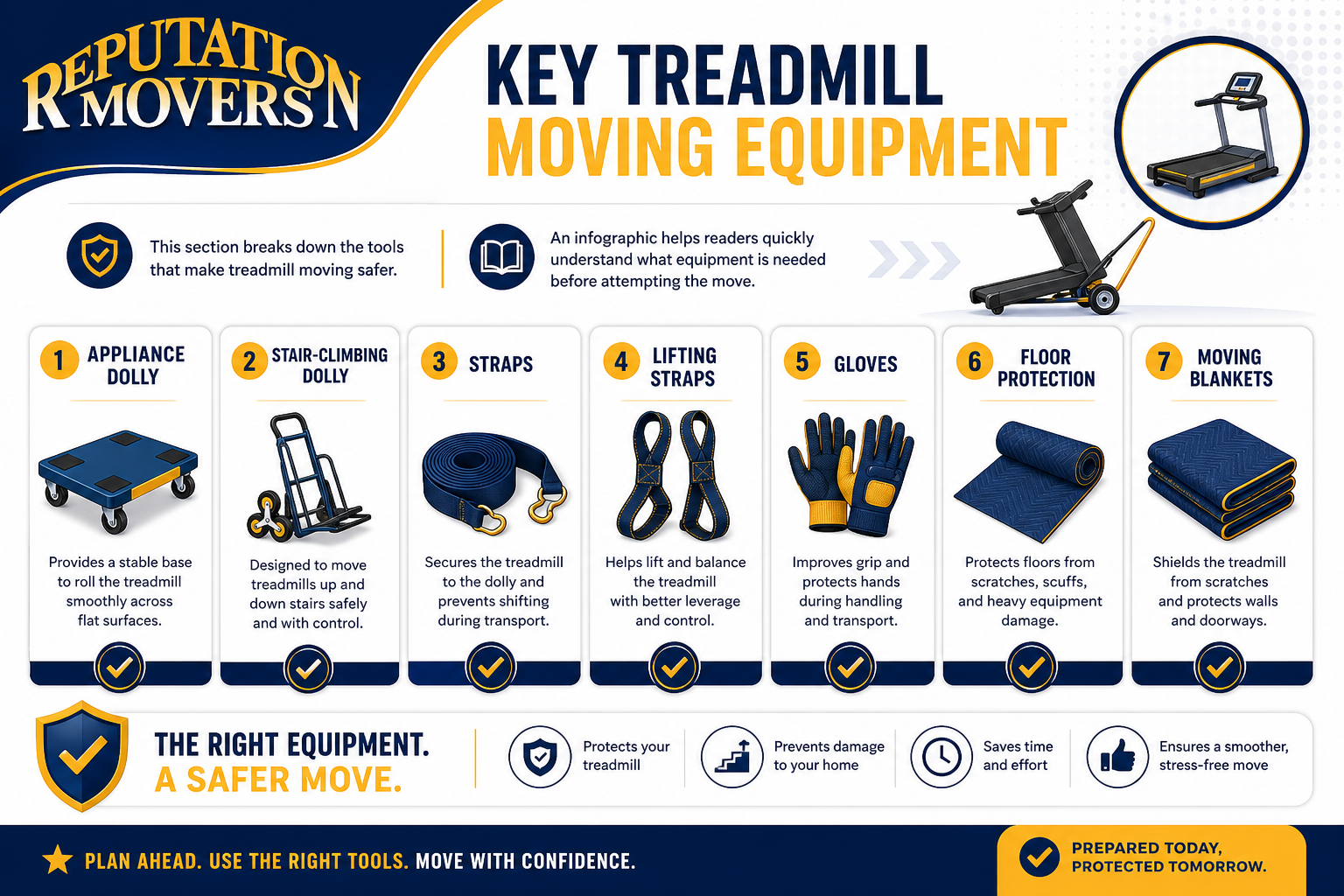
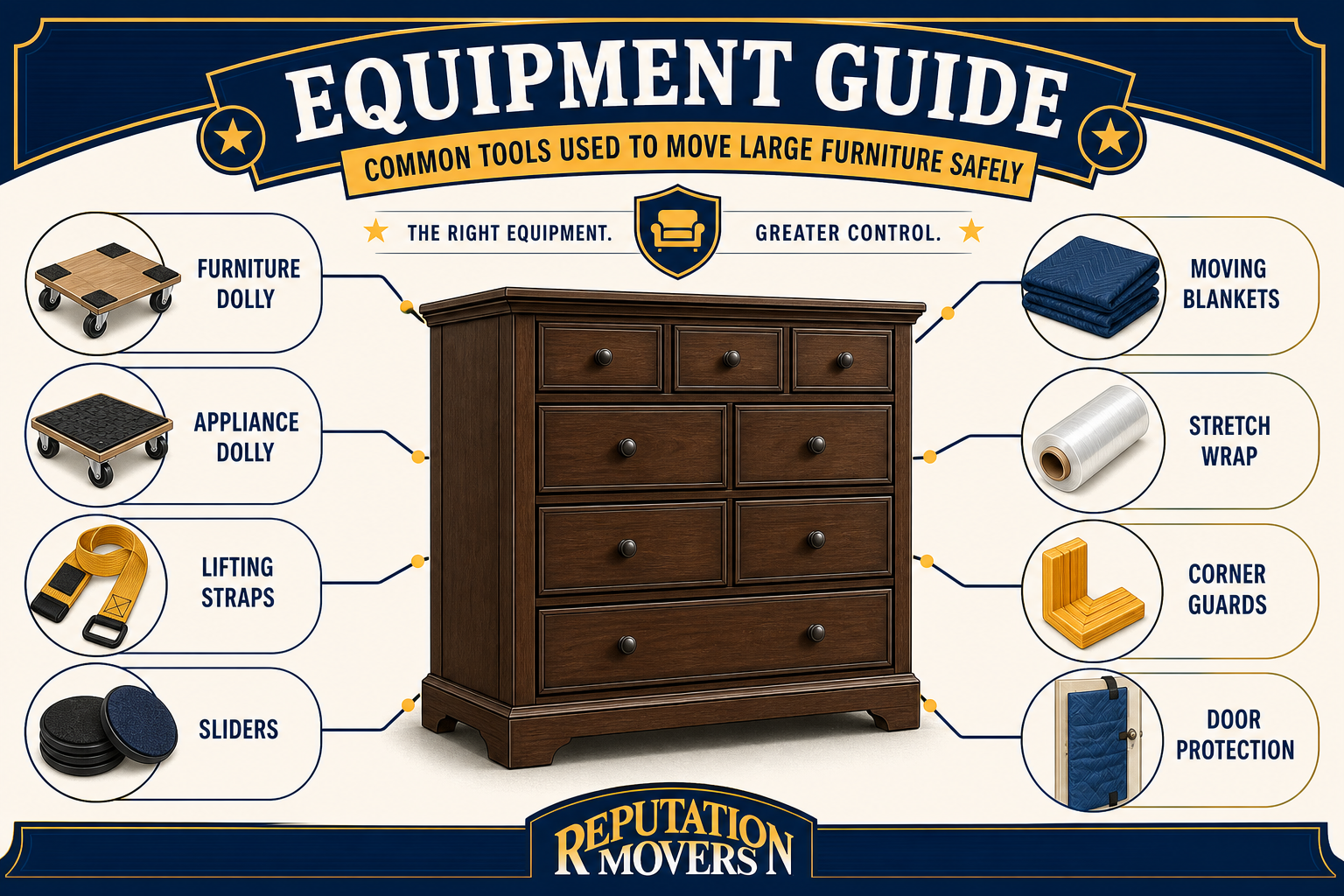
Technique matters, but equipment is just as important. A treadmill without built-in wheels should not be carried through long hallways by hand if a rated dolly can be used. The right dolly helps control the motor-heavy end and reduces strain on the people moving it.
Furniture dollies, appliance dollies, and stair-climbing dollies are commonly recommended for treadmill moves. The equipment must be rated for the load, especially when the treadmill may weigh 200 to 400 pounds or more.
Once the treadmill is on the dolly, it should be strapped securely. At least two ratchet or cam straps are often recommended, one near the top of the frame and one across the middle. This keeps the treadmill from shifting, sliding, or tipping during turns, stairs, and loading.
Use a heavy-duty furniture or appliance dolly for flat movement.
Use a stair-climbing dolly where available for stair moves.
Keep the heavier motor end low for better stability.
Use straps to secure the treadmill to the dolly before moving.
Use lifting straps only when repositioning or lifting is unavoidable.
Wear gloves with good grip to maintain control on smooth surfaces.
Pause often instead of letting momentum build.
For staircases, professional moving crews use controlled step-by-step movement, constant communication, and equipment designed for heavy items. The treadmill should never be allowed to roll freely down stairs.
Common DIY Treadmill Moving Mistakes Cause Expensive Damage
The most common mistake is underestimating the treadmill’s weight. Some full-size treadmills exceed 300 to 400 pounds, and large gym-style models may reach 500 to 590 pounds. That is far beyond a casual two-person lift, especially on stairs.
Another common mistake is assuming that folding the treadmill means it will fit. Folding usually shortens the machine, but the width often stays the same. If the console or handrails are too wide for a doorway, forcing the treadmill through can damage the folding lock, stress the frame, crack plastic shrouds, gouge jambs, or chip trim.
Dragging is another problem. Heavy treadmill feet and wheels can dent hardwood, tear vinyl, and crack tile. Pushing the treadmill sideways can also cause the running belt to shift off-center, which may require adjustment after the move.
Disassembly mistakes can be just as frustrating. Removing console parts without labeling wires or tracking hardware can create reassembly problems later. Misrouted cables, pinched wires, incorrect bolts, and misaligned handrails can affect how the treadmill works after it is set up again.
After Reassembly, Test the Treadmill Slowly
Once the treadmill is in its new location, reassembly should be treated as part of the move, not an afterthought. Reconnect wires according to labels and photos. Reinstall bolts in the correct locations. Make sure the frame is square and all folding locks are properly engaged.
After plugging in the treadmill, test it at a low speed, often around 1 mph, to confirm the belt tracks smoothly and the console powers on. If the belt squeaks, slips, or drifts off-center, it may need adjustment.
Incline mechanisms should also respond correctly if the treadmill has that feature. Any unusual noise, shifting, or instability should be addressed before regular use resumes.
Professional Movers Treat Treadmills as Specialty Items, Not Regular Furniture
Professional movers who regularly handle home gym equipment use a different process for treadmills than they would for ordinary furniture. The work begins with identifying the model, weight, folded dimensions, and disassembly options. Then the moving path is measured before the treadmill is lifted.
For complex or heavier units, movers may remove handrails, console masts, or other components allowed by the manual. They label wiring, organize hardware, pad the components, and protect the main deck, which contains the belt, rollers, and motor.
During movement, the main treadmill section is typically secured to a rated appliance or stair-climbing dolly. Professional guidance emphasizes securing heavy gym machines with straps, using floor protection, and moving with trained handlers because two people are usually needed for flat movement and three are often safer for stairs or tight turns.
In the vehicle, treadmills are commonly transported upright when folded, braced so they cannot shift, and never stacked under heavier items. Even a short local drive can damage a treadmill if the frame twists, the console hits another item, or the machine slides during transit.
At the destination, professional reassembly follows the same careful logic. Components are positioned, wiring is reconnected, bolts are tightened, folding locks are checked, and the treadmill is tested at low speed. This helps confirm that the machine is safe to use before the move is considered finished.
Why Homeowners Hire Help for the Treadmill Even on Small Local Moves
Many small local moves do not require a large crew for every item. A homeowner may be comfortable moving boxes, small tables, lamps, and lightweight furniture. The treadmill is different because it concentrates a lot of risk into one object.
The cost of a mistake can be high. A dropped treadmill can damage stair treads, railings, hardwood floors, door trim, drywall, or the treadmill’s own console and frame. The injury risk is also real because the motor end can shift unexpectedly and the machine is difficult to grip securely.
Professional movers also bring equipment most homeowners do not keep at home. Appliance dollies, stair-climbing dollies, furniture pads, straps, ramps, floor protection, and door jamb protection can make a major difference when the route includes stairs or tight turns.
Disassembly and reassembly are another reason homeowners bring in help. The process may involve wiring, photos, labeled hardware, console removal, careful padding, and low-speed testing afterward. For many people, hiring movers for the treadmill alone is more practical than risking damage during a DIY attempt.
A Practical Treadmill Moving Decision Checklist
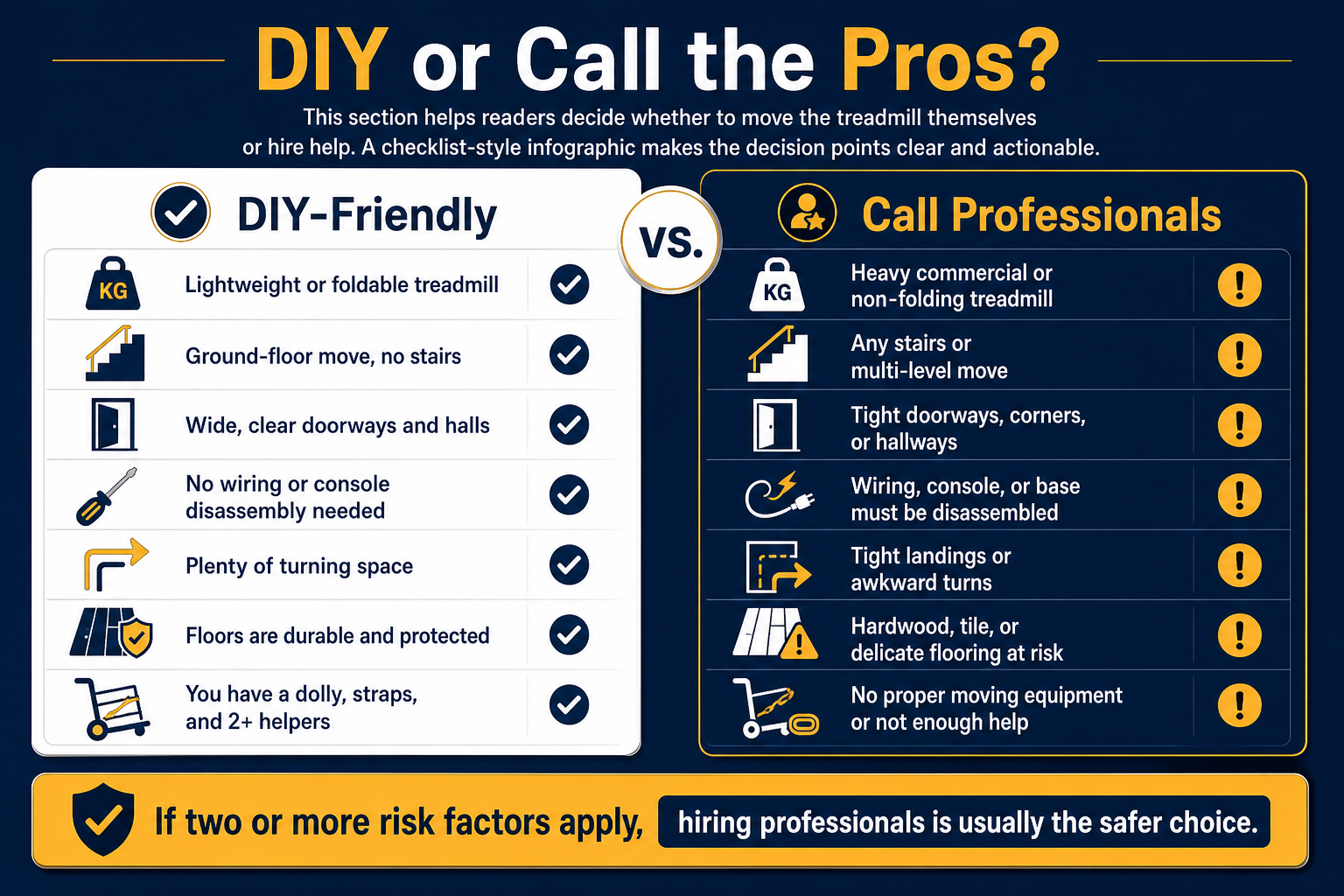
Before deciding whether to move the treadmill yourself or call professionals, look at the actual conditions of your home and equipment. A lightweight folding treadmill on the same level with wide doors is very different from a heavy commercial-framed treadmill in a basement.
Be honest about the route, the stairs, and the number of capable helpers available. If you are missing the right equipment or cannot confirm the treadmill will clear each opening, the move becomes much riskier.
This checklist can help you identify when a treadmill move is moving beyond a simple DIY task.
Call for help if the treadmill weighs more than your team can safely control.
Call for help if stairs are involved, especially narrow or turning staircases.
Call for help if the treadmill is wider than any doorway on the route.
Call for help if partial disassembly requires console or wiring removal.
Call for help if the treadmill must pivot on a small landing.
Call for help if the home has delicate floors, fresh paint, tight trim, or renovated finishes.
Call for help if you do not have a rated dolly, straps, padding, and floor protection.

Get Help Moving a Treadmill Safely in Northern Virginia
Moving a treadmill safely starts with the right plan: confirm the weight, measure the route, decide whether disassembly is needed, protect the home, use the right equipment, and take stairs seriously. If any part of that plan feels uncertain, it is worth getting help before the treadmill is halfway down the steps.
Reputation Movers provides local moving, packing, storage, furniture assembly, staging, and home organizing services for homeowners and renters in Alexandria and surrounding Northern Virginia communities. If your treadmill is the one item making a small move complicated, our team can help handle it with the care, planning, and equipment it requires.
Ready to plan your move? Get a Quote or call Reputation Movers at (703) 660-6683.
















.webp)

.webp)
.webp)
.webp)

.webp)
.webp)








.webp)

.webp)


.png)