.webp)
.svg)
For families planning a move, the phrase “best schools in Northern Virginia” can mean several different things. It may mean the highest ranked district, the strongest high school pyramid, a neighborhood elementary school with excellent parent reviews, or a specialized program that fits a child’s needs. The challenge is that no single ranking answers every question a family has before choosing a home.
School research works best when families compare rankings, official district information, attendance boundaries, and enrollment timing together. A school with a high statewide rank may be a great academic fit, but the home must still fall within the correct boundary, match the family’s budget, and work with commute and move timing.
At Reputation Movers, we help homeowners, renters, and relocating families across Alexandria, Northern Virginia, and the greater DMV area plan moves around real-life priorities like school calendars, registration windows, and settling in before the first day of class. If you have questions while planning a school-year move, we welcome you to reach out for guidance on timing and moving logistics.
School rankings in Northern Virginia are useful starting points, not final answers
Most families begin with rankings because they make a large region easier to compare. Northern Virginia includes several highly regarded public school systems, and rankings can quickly help families narrow their search from the full region to a few districts, pyramids, or neighborhoods.
The most common ranking sources for Northern Virginia schools include Niche, GreatSchools, U.S. News & World Report, and data from the Virginia Department of Education. Each source measures something different, so a school may look stronger on one site than another depending on what the ranking emphasizes.
Niche uses overall letter grades for districts and individual schools. Its ratings include test scores, college readiness, graduation rates, teacher quality, and parent and student reviews. The K-12 Schools in Virginia rankings are often used by families who want a broad snapshot of school reputation and parent sentiment.
GreatSchools uses a 1 to 10 rating system. It focuses on academic progress, equity, and standardized test performance. That can be especially helpful when families want to know not just how students perform overall, but how well different student groups are served.
U.S. News & World Report ranks high schools nationally and statewide using college readiness indicators, including AP and IB participation and performance. This can be useful for families with older students who are comparing academic rigor, advanced coursework, and college preparation.
Top Northern Virginia districts often differ in size, housing cost, and program breadth
Recent Niche data for 2026 places several Northern Virginia districts among the strongest in Virginia. Falls Church City Public Schools ranks #1 in Virginia with an A+ grade. Arlington Public Schools ranks #2 with an A+ grade. Loudoun County Public Schools ranks #4 with an A grade. Fairfax County Public Schools ranks #6 with an A grade. Prince William County Public Schools ranks #14 with an A- grade.
Those district-level grades help families understand the broad landscape, but they do not tell the whole story. District size, median home price, specialized programs, and commute patterns all affect whether a district is the right fit.
Falls Church City Public Schools enrolls roughly 2,800 students and is paired with a median home price around $1,015,000. Its small geography and limited housing inventory can make access competitive. Arlington Public Schools enrolls about 27,500 students, has an A+ grade, and has median home prices near $815,000.
Loudoun County Public Schools serves approximately 81,700 students, carries an A grade, and has a median home price around $774,000. Fairfax County Public Schools is the largest of the group, with roughly 180,000 students, an A grade, and a median home price around $725,000. Prince William County Public Schools enrolls about 91,100 students, has an A- grade, and has a median home price near $555,000.
These numbers show why families often weigh school reputation against home size, price, and commute. The 2026 district rankings and prices illustrate how the highest-ranked districts can also carry higher housing costs.
Falls Church City and Arlington appeal to families seeking A+ districts close to D.C.
Falls Church City and Arlington stand out in broad district rankings. Both have A+ grades, and both are attractive for families who want strong public schools with closer access to downtown D.C. and major employment centers.
The trade-off is housing cost and availability. Falls Church City is geographically small, and limited inventory can make the search more difficult. Arlington has more students and more housing variety, but its school reputation and location also support strong demand.
Fairfax and Loudoun offer many high-performing schools across larger districts
Fairfax and Loudoun are larger systems with broad program offerings. Fairfax County consistently places many high schools on regional top-school lists, including Thomas Jefferson High School for Science and Technology, Langley, McLean, Madison, Oakton, and Marshall.
Loudoun County includes high-performing schools such as Independence, Rock Ridge, and Riverside. Families considering Loudoun often weigh strong schools and newer or larger homes against longer drive times to some job centers.
Prince William can be part of a budget-conscious school search
Prince William County Public Schools has an A- Niche grade and a lower median home price than the other districts highlighted in the research. For families balancing affordability, space, and school quality, it may be part of a broader search strategy.
This does not mean choosing by district rank alone. Families still need to review individual schools, attendance zones, program options, and commute realities before deciding where to live.
High school rankings can shape the home search, especially in popular pyramids
Many Northern Virginia home searches are organized around high school pyramids. A pyramid describes the way elementary and middle schools feed into a high school. Families often start with a desired high school, then work backward to identify elementary or middle school boundaries that feed into it.
Thomas Jefferson High School for Science and Technology in Fairfax County is ranked #1 high school in Virginia and is recognized nationally as a top STEM high school. It is a regional magnet school, so living in a specific neighborhood does not guarantee admission. Families interested in TJHSST must understand the application and admissions process.
Other Fairfax County schools, including Langley High School, McLean High School, Madison High School, Oakton High School, and Marshall High School, regularly appear in discussions of competitive and academically rigorous schools. Arlington’s Washington-Liberty High School and Yorktown High School also appear in statewide and regional lists. Loudoun County’s Independence High School is another frequently cited high performer.
Northern Virginia Magazine’s 2025 list of the top 25 public high schools uses Virginia Department of Education data, including advanced diploma rates, graduation rates, chronic absenteeism, SOL pass-advanced rates, and combined AP/IB enrollment. The Top 25 high schools list gives families a more detailed look at school-level performance than district grades alone.
High school rankings are especially relevant for families with middle- and high-school students. At those ages, advanced courses, AP or IB participation, graduation metrics, and college readiness may carry more weight than broad district reputation.
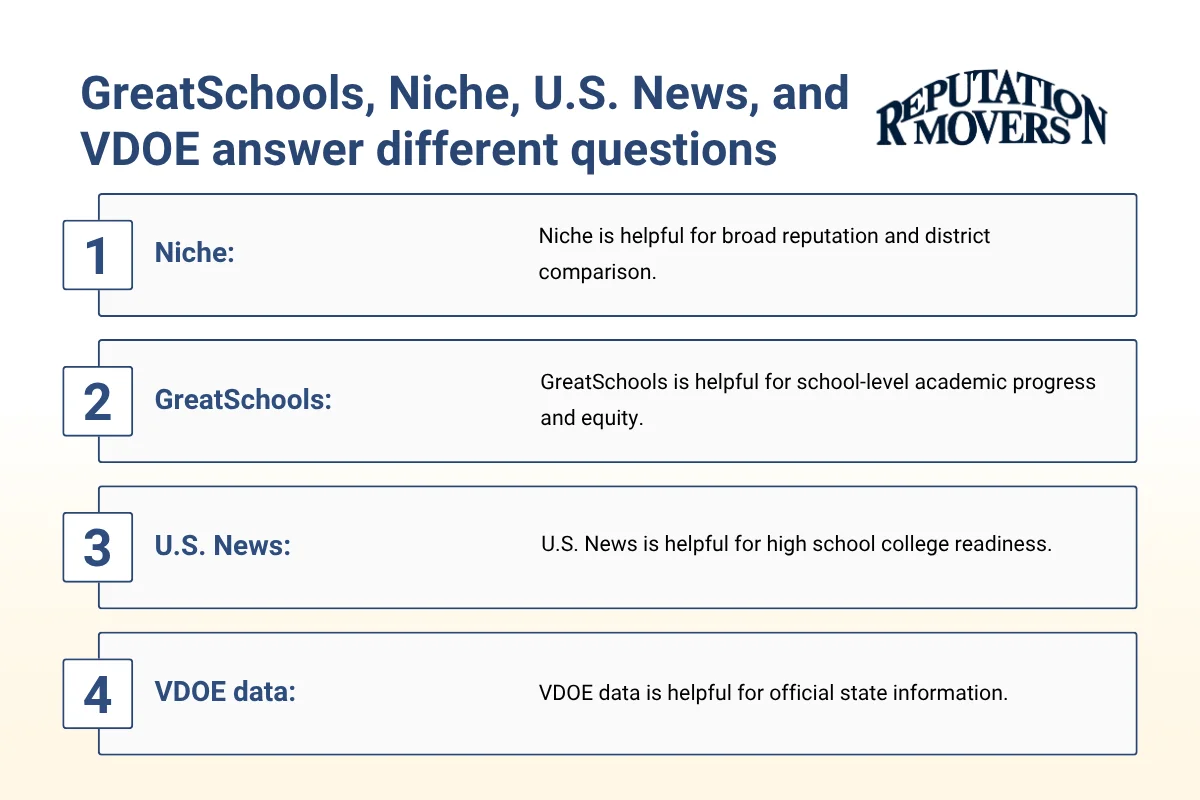
GreatSchools, Niche, U.S. News, and VDOE each answer different questions
A strong school research plan uses multiple sources because each one gives families a different view. Rankings are not interchangeable. They reflect different priorities and should be read with the family’s needs in mind.
Before relying on any score, families should ask what the score is actually measuring. A college-readiness ranking may be helpful for a high school junior but less useful for a kindergarten family. An equity or student progress score may reveal strengths that a simple proficiency snapshot misses.
The main takeaway is to use each source for the question it answers best. Families can then compare the results instead of treating one list as the final word.
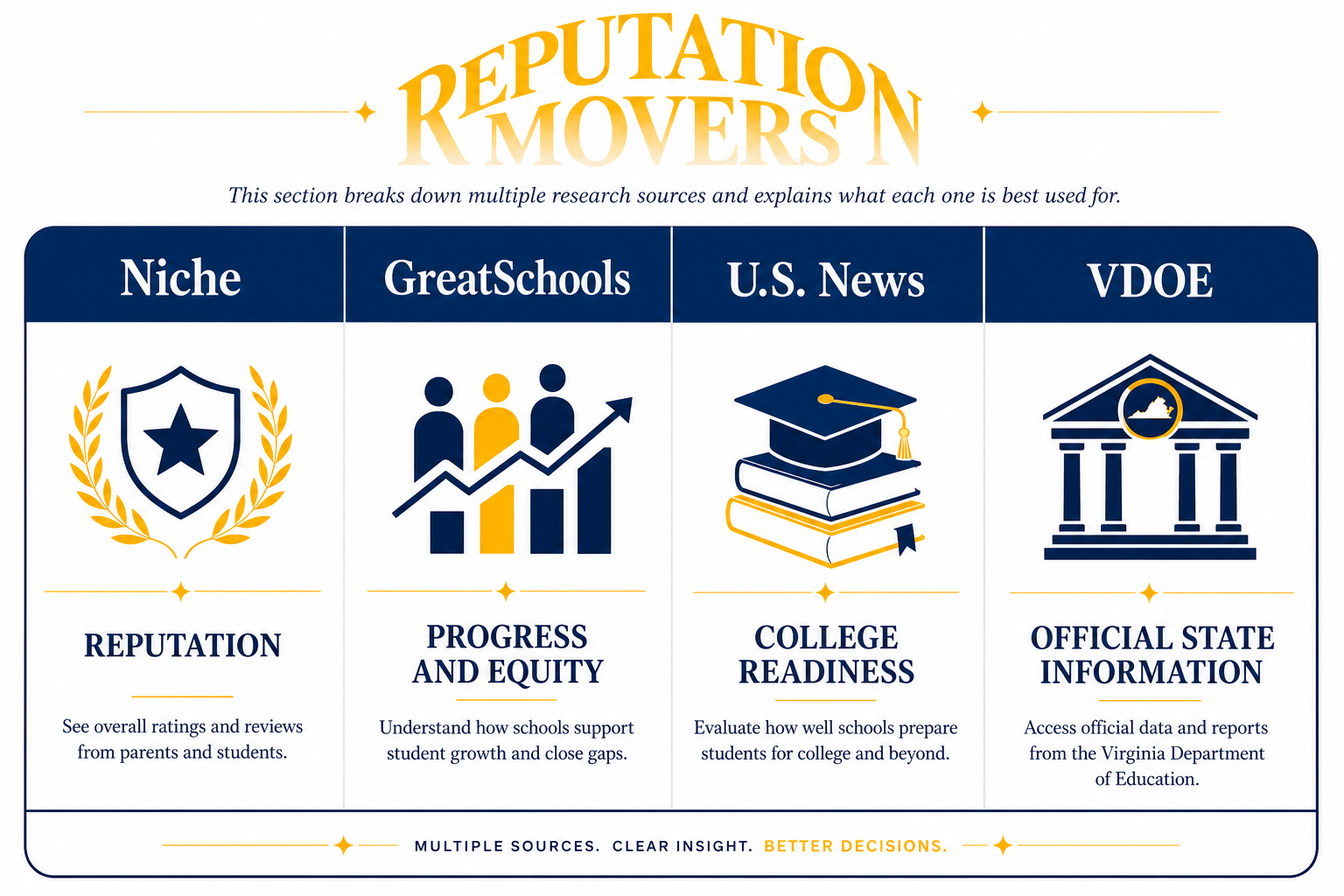
Niche is helpful for broad reputation and district comparison. It combines academic data with parent and student reviews, teacher quality, test scores, graduation rates, and college readiness.
GreatSchools is helpful for school-level academic progress and equity. Its 1 to 10 scale can show how well schools support different student groups and how students are progressing.
U.S. News is helpful for high school college readiness. Its high school rankings emphasize AP and IB participation and performance, which can matter for college-bound students.
VDOE data is helpful for official state information. Families can use state data, directories, calendars, and related resources when checking school divisions, school years, and official education details.
Local and regional rankings add context. Northern Virginia Magazine’s list, for example, uses VDOE performance indicators to compare public high schools across the region.
Attendance boundaries can matter as much as the school ranking
A home being near a school does not always mean it is assigned to that school. In Northern Virginia, school boundary maps, also called attendance zones or polygons, determine which public school a child is assigned to.
This is one of the most important details in a school-driven home search. A listing may mention a desirable school nearby, but families should verify the official assignment before making decisions tied to that school.
The Virginia Open Data Portal hosts school boundary polygon datasets that describe attendance boundaries for districts such as Arlington. Arlington Public Schools also publishes PDF maps showing elementary school locations and attendance zone boundaries, including maps tied to board-adopted boundaries.
Boundary lines can change over time because of enrollment growth, capacity issues, and district decisions. That is why families should confirm current assignments directly through district tools before buying or signing a lease.
Attendance boundaries also affect specialized programs. Gifted centers, regional special education classrooms, and language immersion programs may be hosted at certain campuses while serving students from multiple zones. In other cases, placement may depend on living in a certain boundary or securing a lottery seat.
Specialized programs require earlier research than neighborhood school assignments
Families researching the best schools in Northern Virginia often look beyond neighborhood assignments. Special education services, gifted programs, language immersion, private schools, charter options, and magnet programs can all influence where a family wants to live and when they need to move.
These options often come with their own deadlines, placements, eligibility rules, or application steps. That means school research should begin before the move date is fixed, especially for families relocating from another district or state.
Parents should identify which programs matter most, then check the relevant district or state resources. The goal is not just to find a strong school, but to make sure the child can access the needed program after the move.
Special education services may depend on program placement. Students with IEPs may receive services at a neighborhood school or at a regional classroom located at a specific campus.
Gifted and advanced academic programs vary by district. Fairfax, Loudoun, and Arlington maintain advanced or gifted options, and some are housed at designated campuses.
Language immersion may involve boundaries or lotteries. Arlington and Fairfax operate immersion programs, commonly Spanish, at specific schools.
Magnet options require separate planning. TJHSST serves advanced STEM students through a selective admissions process rather than standard neighborhood assignment.
Private school timelines are separate from public school registration. Families considering private schools need to account for applications, tuition planning, and transportation.
The Virginia School Directories page includes statewide directories, division calendars, maps, and contact information for resources such as the Special Education Ombudsman and Military Families School Liaison Officers.
This is also where moving logistics can become more sensitive. Reputation Movers often sees that families with specialized school needs may need extra time for records, placement meetings, and registration steps, so building flexibility into packing, storage, and delivery dates can make the transition smoother.
School calendars should guide the moving schedule, not just the home search
Once a family has narrowed down districts, schools, or boundaries, timing becomes the next major issue. A well-ranked school does not remove the practical stress of arriving too close to the first day of class, missing registration windows, or trying to unpack during orientation week.
The Virginia Department of Education publishes division calendars for each school year, including calendars for 2025-2026 and information about divisions that open before Labor Day. Most Northern Virginia districts start classes in late August, with some local variation.
For many families, late July or early August is the preferred moving window. That timing can allow children to settle into the new home, complete registration, attend open houses, and adjust before classes begin.
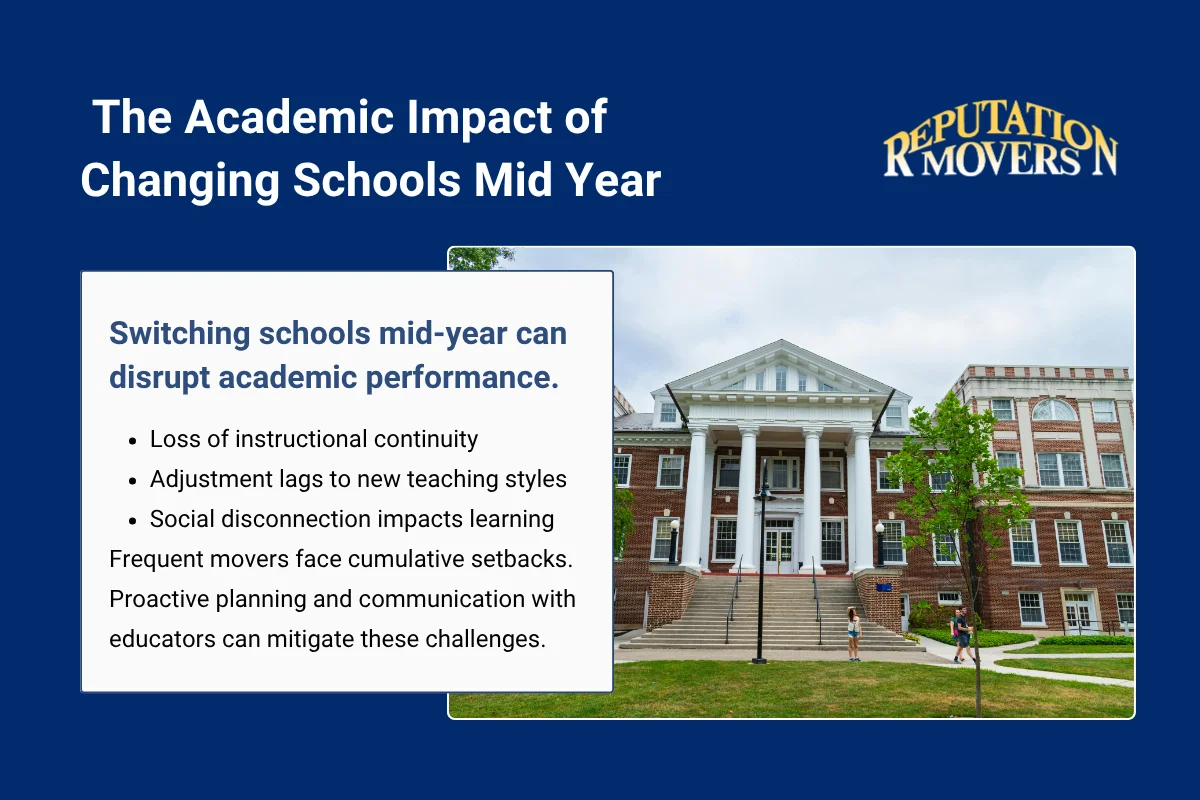
Mid-year moves can work, but they require careful coordination. Families may need to withdraw from a previous school, transfer records, register in the new district, and address placement questions for gifted, special education, or immersion programs. Winter break can sometimes create a natural pause, though activities and sports may already be underway.
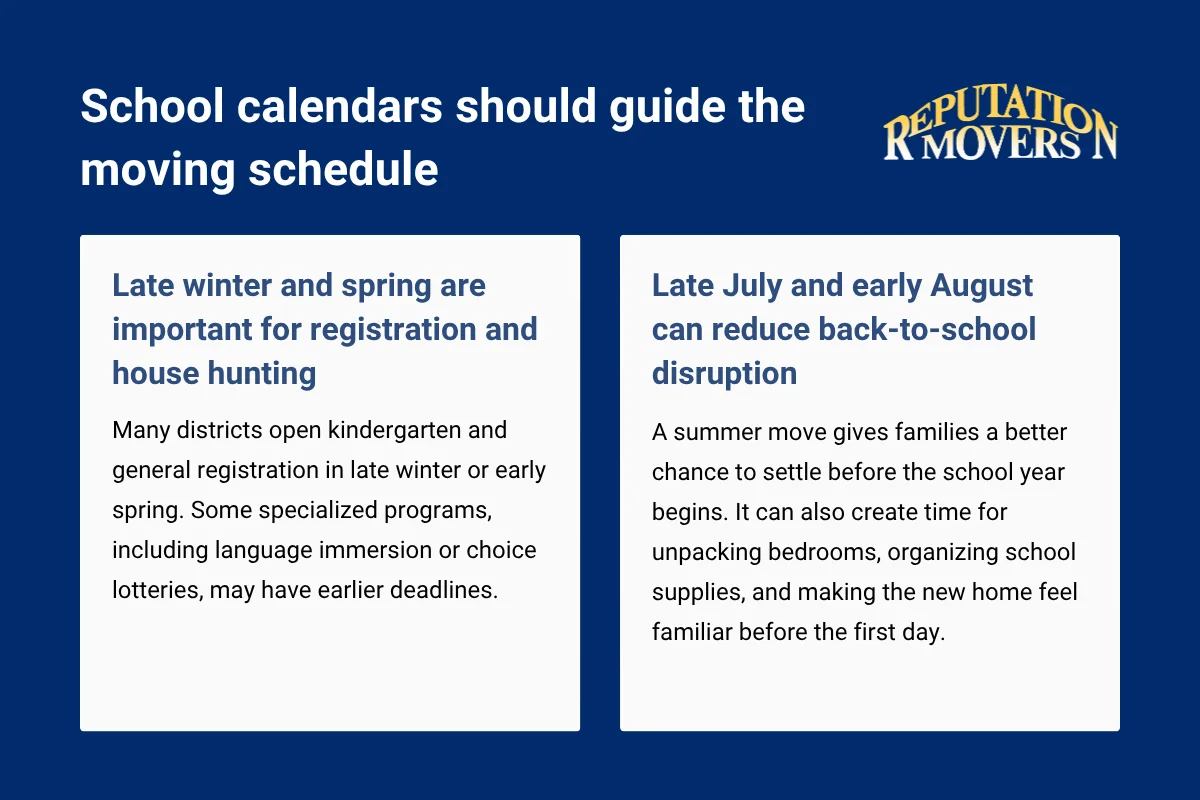
Late winter and spring are important for registration and house hunting
Many districts open kindergarten and general registration in late winter or early spring. Some specialized programs, including language immersion or choice lotteries, may have earlier deadlines.
This means families planning a fall start should ideally begin school research before the summer rush. By spring, they may need to be comparing homes, confirming boundaries, preparing paperwork, and reserving moving dates.
Late July and early August can reduce back-to-school disruption
A summer move gives families a better chance to settle before the school year begins. It can also create time for unpacking bedrooms, organizing school supplies, and making the new home feel familiar before the first day.
For out-of-state moves, arriving several weeks before school starts can be especially helpful. Families may need time for registration appointments, school tours, immunization records, transcripts, and placement conversations.
Ranking release cycles can influence relocation decisions
School rankings are updated regularly. Niche releases updated Best School Districts lists annually, and recent 2026 rankings highlighted Falls Church City, Arlington, Loudoun, Fairfax, and Prince William. Northern Virginia Magazine’s Top 25 high schools feature was published in November 2025 using VDOE data.
Families who closely follow these updates may adjust their home search when new rankings appear. That can affect spring and early-summer demand in popular school zones.
A practical research sequence helps families compare schools without getting overwhelmed
School research can become difficult when every source seems to point in a different direction. A structured approach helps families make steady progress from broad comparisons to address-specific decisions.
The best process starts wide, then narrows. Families can begin with district-level rankings, then compare individual schools, then confirm boundaries, then review specialized programs and enrollment timing.
This sequence also helps prevent a common mistake: falling in love with a home before confirming the official school assignment. It is better to check boundaries and registration requirements before committing to a move date.
Start with district rankings. Use Niche-style district grades to compare Falls Church City, Arlington, Loudoun, Fairfax, and Prince William at a high level.
Compare specific schools inside each district. Review high school rankings, GreatSchools ratings, and VDOE-based indicators when available.
Check the school pyramid. Confirm how elementary and middle schools feed into the high school the family is targeting.
Verify the attendance boundary by address. Use official district maps, GIS tools, or district lookup tools before relying on listing language.
Research specialized programs early. Check gifted, special education, immersion, magnet, private, and charter options before finalizing a move plan.
Align the move with the school calendar. Build in time for registration, records, tours, orientation, and unpacking before classes start.
Families should balance school quality with commute, cost, and daily life
The best schools in Northern Virginia are not always the best fit for every household. A highly ranked district may come with higher home prices, smaller housing inventory, or a commute that does not work for the family’s schedule.
Falls Church City and Arlington offer strong rankings and closer access to D.C. and major employment centers. Fairfax provides a large and varied district with many strong high school pyramids. Loudoun may appeal to families seeking strong schools and larger or newer homes, while Prince William can be part of a more budget-conscious search.
Families with young children may prioritize elementary ratings and plan to reassess later. Families with older students may focus more on AP/IB options, advanced diploma rates, high school rankings, and college readiness. Families with specialized needs may place program access above a general district grade.
The strongest relocation plan accounts for all of these factors together. School quality matters, but so do commute patterns, budget, home size, program eligibility, and the emotional timing of the move.
Plan a school-year move with clear dates, verified boundaries, and room to settle
Researching the best schools in Northern Virginia is not just an academic exercise. It shapes where families search for homes, when they make offers, how they evaluate neighborhoods, and how quickly they need to move once housing is secured.
Families can make the process easier by using rankings as a starting point, confirming boundaries through official tools, checking specialized program requirements early, and choosing move dates that leave enough time for school registration and adjustment.
If your family is preparing for a local or long-distance move tied to Northern Virginia schools, Reputation Movers can help coordinate packing, moving, storage, furniture assembly, and home organization around your school calendar. Get a Quote by calling (703) 660-6683 or visiting https://www.reputationmovers.com/contact-us.




















.webp)


.webp)
.webp)
.webp)

.webp)
.webp)












.webp)

.webp)


.png)