.webp)
.svg)
Moving large furniture is rarely just a strength test. Couches, sectionals, armoires, wardrobes, tall bookcases, and heavy dressers create problems because they must fit through real spaces: older doorways, stair turns, elevator openings, lobby corners, and final room entries. A piece can look manageable in an open room and still become difficult at the first landing or hallway turn.
The safest approach starts before lifting. Professional movers measure the furniture, measure the route, decide whether the item should stay assembled or be partially disassembled, and protect the home or building before the first heavy piece moves. That planning is what helps prevent stuck furniture, scratched floors, wall marks, and rushed decisions on move day.
At Reputation Movers, we help homeowners, renters, condo residents, and apartment dwellers in Alexandria, Northern Virginia, and the greater DMV area plan moves around these exact challenges. If you have questions about a large couch, sectional, armoire, or heavy piece before your move, we welcome you to reach out for practical guidance.
Large furniture moves safely when fit, route, and protection are planned together
The central decision in moving large furniture is whether the piece can pass safely through the route in one piece. If it can clear every doorway, hallway, turn, stair landing, or elevator opening with enough control, movers may keep it assembled. If it cannot, they usually look at partial disassembly, a different carry angle, or another route.
Fit is not based on the front door alone. A sofa may clear the entry but fail at a stair turn. A tall wardrobe may pass through a hallway but not tilt properly inside an elevator. A dresser may fit through a doorway only after drawers, mirrors, or protruding parts are removed.
Good planning also includes surface protection. Large furniture tends to make contact at corners, railings, thresholds, elevator entrances, and tight pivots. Movers prepare those areas before the item moves, so the route is protected from the beginning rather than patched after damage occurs.
Professional movers decide between disassembly and moving furniture assembled based on clearance and control
Professional movers generally treat fit and safety as the deciding factors. If a couch, sectional, armoire, or other oversized item will not clear the route in one piece, disassembly becomes the safer choice. If it can pass with sufficient clearance and controlled handling, it may move assembled.
The first step is measurement. Movers compare the furniture’s height, width, depth, and protruding parts with the narrowest usable openings along the route. That includes doorways, halls, stairs, landings, elevator doors, elevator cabs, and the entry to the final room.
A moving day fit calculator reflects this practical approach by focusing on the relationship between furniture dimensions and route dimensions such as doors, stairs, elevators, and trucks. The important lesson is simple: the narrowest point controls the move, not the widest or most convenient opening.
Couches and sectionals often need legs, cushions, or modules removed first
For couches and sectionals, movers usually begin with the easiest reductions. Cushions come off. Legs may be removed. If the sofa is modular, individual sections can often be separated at the seams or connectors.

This kind of partial disassembly can make a large piece lighter, narrower, and easier to control. It can also reduce the risk of the frame catching on a door jamb or the upholstery rubbing against a wall during a pivot.
Movers may also use an angled carry or hook method, where one end of the couch is guided through an opening first and the piece is pivoted through. If that still does not work, the next steps may include removing couch legs, taking a door off its hinges, or fully separating sectional sections when the furniture is designed for it.
Armoires, wardrobes, dressers, and bookcases become safer when removable parts are taken off
Tall and top-heavy furniture creates a different risk. Armoires, wardrobes, tall bookcases, and dressers can be awkward to tilt, especially on stairs or landings. Removing drawers, shelves, mirrors, doors, legs, or modular sections can reduce weight and improve balance.
This does not mean every piece should be taken apart completely. Disassembly should be purposeful. Removing the wrong parts can weaken the structure or create unnecessary reassembly problems.
When hardware is removed, movers commonly place screws, bolts, and small parts into labeled bags and attach them to the matching piece. That keeps reassembly organized and prevents small parts from disappearing during transport.
Older homes create moving challenges because the tightest point is often hidden in the route
Older homes often require extra planning because doorways, turns, trim, and stair routes may be less forgiving. Interior doorways may be around 32 to 36 inches wide, and older properties can have narrower openings, tighter trim, sharper turns, and lower-clearance stair paths.
That means a tape measure must follow the entire route. A front door measurement is helpful, but it does not tell the full story. Movers also look for doorstops, knobs, trim, low-hanging fixtures, ceiling obstructions, railings, and any spot where the usable clearance is smaller than the measured opening.
In many older homes, the limiting factor is not a straight doorway. It is the turn at the top of the stairs, the landing depth, the hallway corner, or the final room entry. These are the places where a large couch or heavy cabinet is most likely to get stuck or make contact with finished surfaces.
Advance measurements help prevent forced carries and last-minute decisions
Pre-move measuring is one of the best ways to prevent surprises. Movers record the dimensions of the item and the dimensions of the route. Then they decide whether the piece can move straight, at an angle, tilted, or in sections.
For sofas and sectionals, measurements are most useful after removable parts are taken off. Cushions, legs, handles, and detachable sections all affect the effective size of the item. Measuring before and after removal can clarify whether a piece should stay assembled or be broken down.
Diagonal clearance also matters. A couch that seems too wide for a doorway may pass when angled correctly. A tall piece may fit in an elevator only when tilted inside the cab. This is why movers pay attention to more than height and width alone.
Route sketches and photos make large furniture moves more predictable
Simple documentation can make a move smoother. Movers may use route sketches, photos of furniture before disassembly, and notes on pinch points from the truck to the final room. These details help the crew understand the move before they begin lifting.
A route sketch does not need to be complicated. It should identify narrow hallways, stair landings, elevator thresholds, lobby corners, and final room doors. The purpose is to decide where the furniture will need to be angled, turned, lifted, protected, or disassembled.
Photos are especially useful when hardware, legs, shelves, or modules are removed. They give the crew a visual reference for reassembly and help keep the process organized.
Condos and apartments add elevator rules, shared spaces, and building access limits
Moving large furniture in condos and apartments requires a wider plan than a single home route. The furniture must pass through the unit, the hallway, the elevator or stairwell, the lobby, and the loading area. Each segment can create a different bottleneck.
Elevators are especially important. Movers check the elevator door width, cab width, cab depth, cab height, and diagonal clearance. A tall item may fit only when tilted inside the cab, and that tilt must still be controlled safely.
Building logistics can also affect the move. Elevator reservations, loading zones, move-in windows, access codes, and freight-elevator rules may determine when and how the crew can work. A measuring for delivery guide emphasizes the importance of checking access points and route dimensions before delivery or moving day.
In shared buildings, protection extends beyond the customer’s front door. Hallways, elevator interiors, lobby corners, and common-area flooring may all need padding, runners, or shields. This helps prevent damage and supports a more orderly move through spaces used by other residents.
This is where Reputation Movers’ careful approach is especially valuable. For moves involving condos, apartments, older homes, and shared access routes, we focus on padding, floor protection, and controlled handling before heavy items begin moving.
Padding and floor protection reduce damage risk during large furniture moves
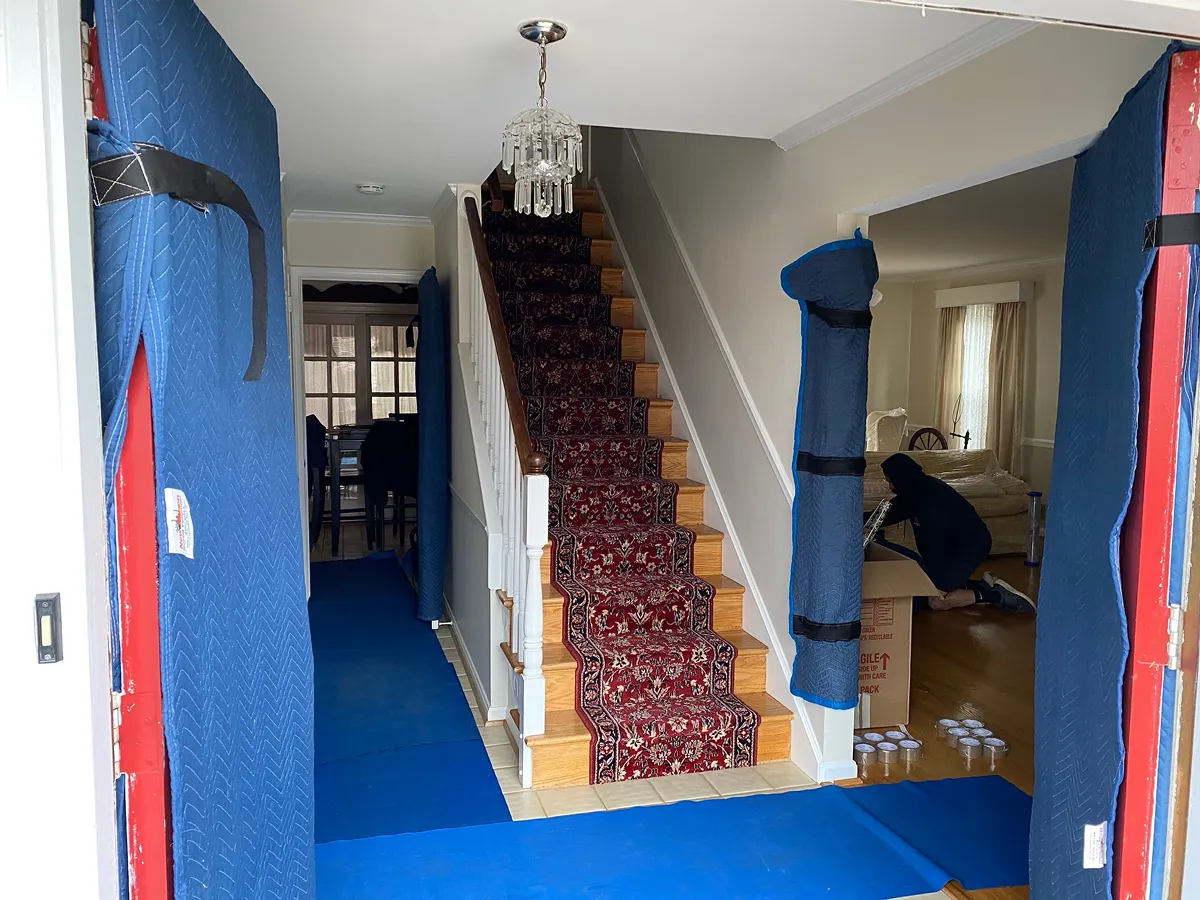
Protection starts before the first oversized item moves. Movers map the route and prepare floors, walls, corners, railings, and other contact points. The goal is to create a protected path from the item’s starting location to the truck, and then from the truck to the item’s destination room.
Large furniture tends to cause damage in predictable places. A sofa can rub a door frame during an angled carry. A dresser can bump a stair railing during a landing turn. A tall bookcase can graze a ceiling or wall when tilted.
Because the risk points are predictable, they can be prepared in advance. Movers use surface protection to prevent scratches, scuffs, moisture transfer, grit transfer, and repeated contact damage along the travel path.
Floors need protection before dollies, feet, and heavy furniture move across them
Hardwood floors, entryways, and high-traffic paths are especially vulnerable during a large furniture move. Dirt or grit can be tracked inside and ground into the floor. Heavy items can scratch finishes if dragged. Dollies can also create marks if the route is not prepared.
Professional movers commonly use floor runners, rosin paper, Ram Board, carpet film, rigid boards, or other floor coverings in the travel path. The exact choice depends on the surface and route, but the purpose remains the same: protect the floor before weight and traffic cross it.
One principle is consistent across professional guidance: furniture should be lifted, not dragged. Dragging is a major cause of floor damage. When a piece must be repositioned, movers use proper lifting, sliders, dollies, or controlled handling instead of pulling heavy furniture across finished surfaces.
Walls, corners, door frames, and railings need protection at pivot points
Large furniture usually contacts the home at turns and thresholds. That is why walls, door frames, corners, banisters, and railings receive special attention. These are the areas where a heavy item is most likely to brush, pivot, or shift during a tight maneuver.
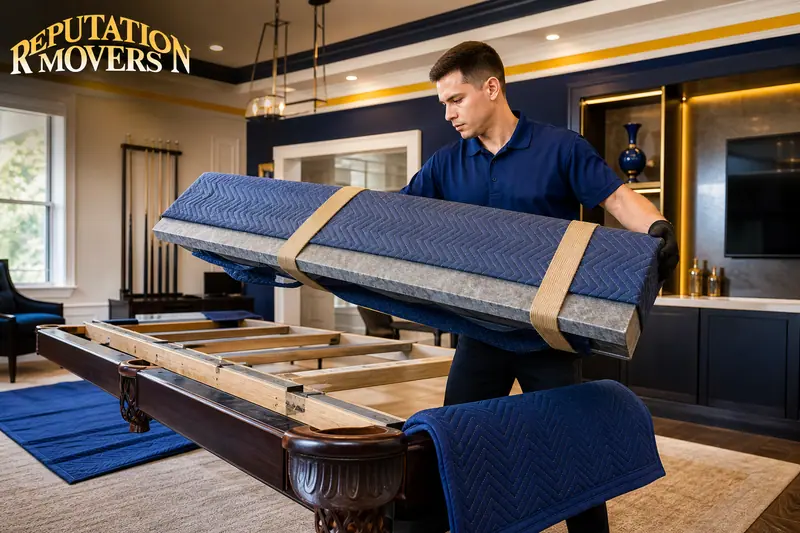
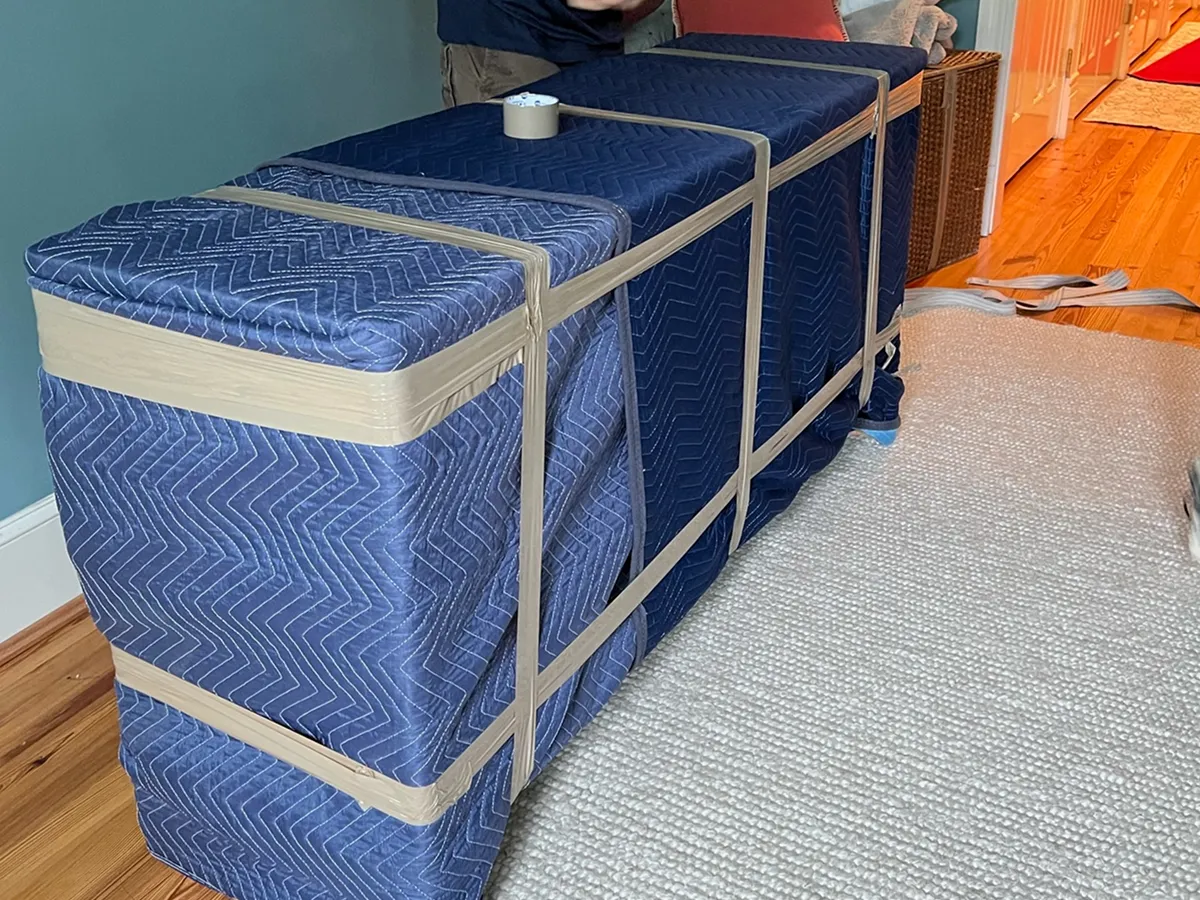
Movers may use moving pads, door-jamb shields, foam corner guards, and banister wrapping to protect these contact points. Padding the furniture itself is also important because it cushions the item and reduces the chance of direct contact with the home.
Protection should be secured carefully. Professional guidance notes that protective materials should be attached so tape stays on the padding rather than directly on finished wood or delicate painted surfaces whenever possible.
Professional equipment helps movers control weight instead of relying on brute force
Moving large furniture safely depends on control. Heavy pieces must be guided through tight spaces without sudden drops, scraping, or twisting. The right equipment reduces lifting strain and helps the crew keep the item stable through each stage of the route.

Equipment also protects the home. A well-padded item on the right dolly is easier to steer than a heavy piece carried in a strained position. Sliders, straps, and blankets help movers use controlled movement rather than forcing a difficult carry.
The most common tools support lifting, rolling, sliding, wrapping, and shielding. Each has a specific purpose, and the best movers choose tools based on the route and item rather than using the same setup for every piece.
Furniture dollies help move heavy items across suitable protected paths with less strain.
Appliance dollies and hand trucks help with tall or bulky pieces that need upright control.
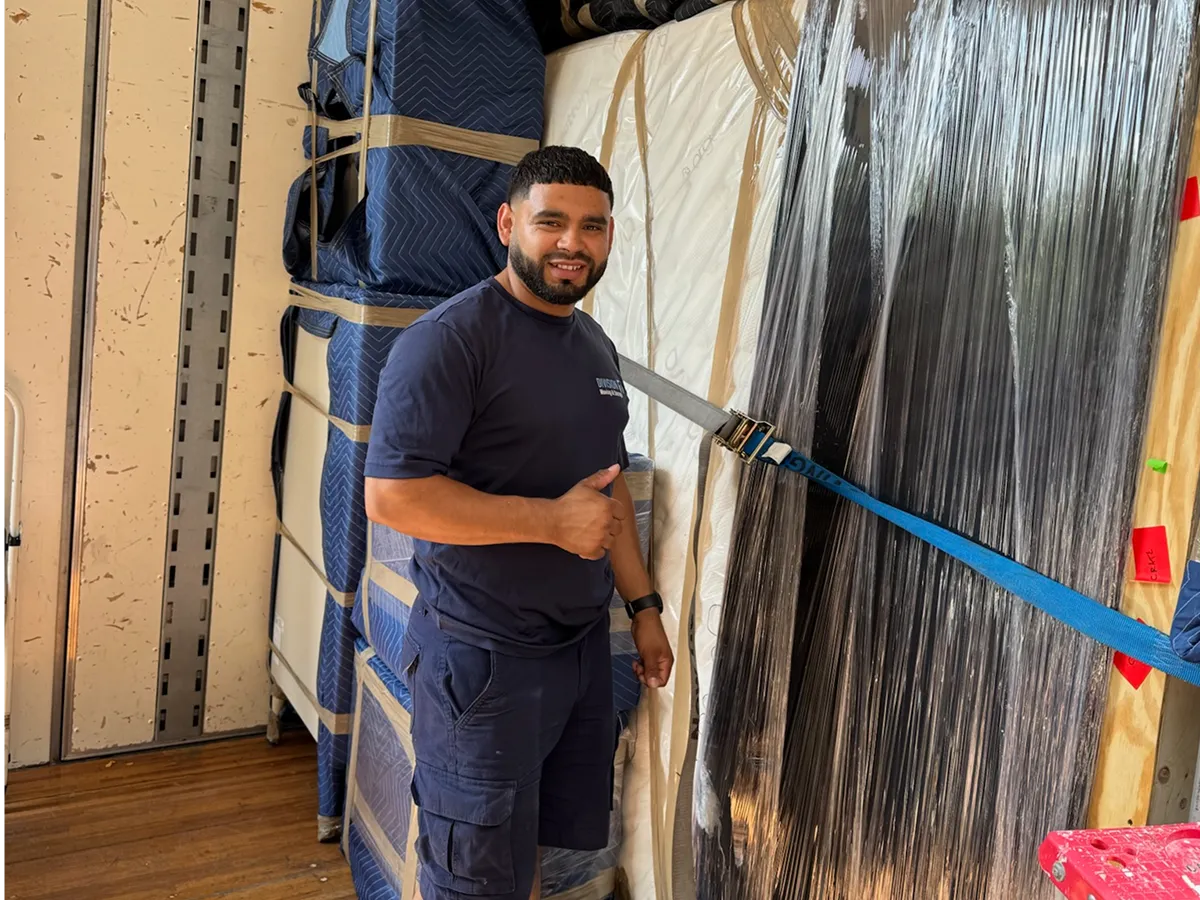
Lifting straps help distribute weight and improve control during carries.
Furniture sliders can help reposition heavy items without dragging them across bare floors.
Moving blankets and stretch wrap protect furniture surfaces and keep padding in place.
Corner guards and door protection help shield the route at tight contact points.
Rope, hoisting straps, and controlled rigging may be considered when an item cannot safely pass through an interior route.
Some restrictive moves require specialized access methods after a site assessment. Examples include high-rises, walk-ups, or homes where no practical interior path exists. In those cases, movers may evaluate hoisting or other methods, along with any building coordination or permit requirements that apply.
Partial disassembly should make furniture safer, not create avoidable reassembly problems
Disassembly is useful when it improves fit, weight, and control. It is not a goal by itself. Taking apart too much furniture can slow the move and create unnecessary reassembly challenges.
The best approach is partial and purposeful. Movers remove the parts that make the item too large, too heavy, or too awkward, while preserving the structure whenever possible. This is especially important for pieces that are not designed to be fully disassembled.
Ready-to-assemble and modular furniture may separate cleanly into sections. Other furniture may allow only limited removal, such as legs, shelves, drawers, or doors. Movers look for the difference before forcing a piece apart.
Labeling hardware and wrapping parts protects both the move and reassembly
When a piece is disassembled, organization matters. Screws, bolts, connectors, legs, shelves, and small hardware should be grouped and labeled. The labeled bag should stay with the matching furniture piece whenever possible.
Modular sections should be wrapped individually in blankets or pads. This protects surfaces during loading, transport, unloading, and reassembly. It also makes each section easier to handle through stairs, elevators, and room entries.
Photos taken before and during disassembly can help the crew put the item back together correctly. This is especially useful for sectionals, wardrobes, and furniture with multiple removable parts.
A practical moving large furniture checklist for homeowners, renters, and condo residents
Large furniture moves go better when the customer and moving crew understand the challenges before move day. You do not need to solve every route problem yourself, but sharing accurate information helps movers prepare the right plan, tools, and protection.

The checklist below reflects the same planning sequence movers use: measure the item, measure the route, identify building rules, prepare protection, and decide whether disassembly is needed. It is especially helpful for older homes, condos, apartments, townhouses, and any move involving heavy or oversized pieces.
Before the move, walk the path from the furniture’s current location to the truck and from the truck to the new room if possible. Pay close attention to turns, landings, elevator access, and final room entries, not just the front door.
Measure the height, width, and depth of each large furniture item.
Measure the item again after removing cushions, legs, handles, or detachable sections.
Record the narrowest doorway width and height along the route.
Measure hallway widths, stairwell width, ceiling height, and landing depth.
Check elevator door width, cab width, cab depth, cab height, and diagonal clearance.
Look for door knobs, trim, doorstops, low fixtures, railings, and ceiling obstructions.
Identify where the furniture may need to be angled, tilted, or separated into sections.
Confirm elevator reservations, loading zones, move-in windows, access codes, and freight-elevator rules when applicable.
Take photos before disassembly so reassembly is easier.
Keep screws, bolts, and small parts in labeled bags attached to the matching piece.
Clear hallways and rooms before the crew arrives so protection can be placed efficiently.
Point out hardwood floors, delicate painted surfaces, tight turns, and shared common areas that need extra care.
This preparation reduces surprises. It helps the moving crew avoid forced carries, unnecessary door removals, trapped furniture, and rushed decisions around fragile surfaces. It also gives everyone a clearer plan for how each large piece will move.
The safest large furniture moves use the least-force path that still works
The best large furniture move is not the one that uses the most strength. It is the one that uses the most control. Movers measure first, choose the right angle or disassembly plan, protect the route, and use equipment that reduces strain and contact.
For couches and sectionals, that may mean removing cushions and legs, separating modules, or using an angled hook method through a doorway. For armoires, wardrobes, dressers, and bookcases, it may mean removing drawers, shelves, mirrors, or doors to reduce weight and improve balance.
For older homes, the focus is often on stair turns, trim, low-clearance paths, and final room entries. For condos and apartments, the plan must include elevators, lobby corners, service corridors, shared hallways, and building rules.
Across all of these settings, the workflow remains the same: measure the furniture, measure the route, decide whether to disassemble or angle the item, protect the floors and walls, and move with the right tools instead of brute force.

Get help moving large furniture with careful padding and floor protection
If you are planning a move with oversized couches, sectionals, armoires, wardrobes, dressers, or other heavy pieces, Reputation Movers can help you plan the safest path through older homes, condos, apartments, and tight access routes.
Our team provides local moving, long-distance moving, packing and unpacking, secure storage, furniture assembly and staging, and home organizing services for customers in Alexandria and surrounding Northern Virginia communities.
To get started, call (703) 660-6683 or Get a Quote.


















.webp)

.webp)
.webp)
.webp)

.webp)
.webp)










.webp)

.webp)


.png)